



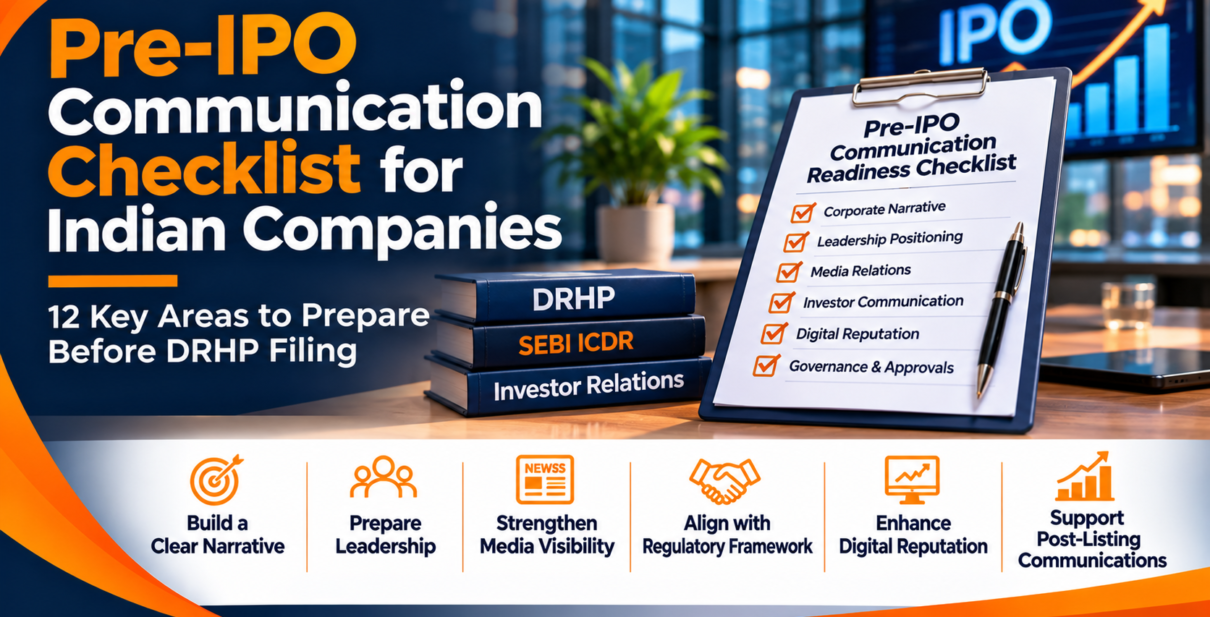
Pre-IPO communication checklist India
Preparing for an Initial Public Offering (IPO) involves more than financial restructuring, legal documentation and regulatory preparation.
A company also needs to consider how its business, leadership, market position and corporate reputation are understood by external stakeholders.
As a company approaches the public markets, its communication may receive greater attention from business journalists, financial media, analysts, investors, customers, employees and industry stakeholders.
This makes pre-IPO communication an important part of corporate readiness.
An organised communication strategy helps companies present their business story consistently, maintain accurate public information, prepare leadership for media interactions and coordinate sensitive communication with their appointed advisers.
For Indian businesses considering a public listing, preparing this communication framework early can help identify reputational gaps before the formal IPO process advances.
If your company is evaluating a pre-IPO PR agency in India, the following 12-point checklist explains what to assess before filing a Draft Red Herring Prospectus (DRHP).
What Is a Pre-IPO Communication Checklist India?
Pre-IPO communication is the structured management of a company’s corporate narrative, leadership communication, media engagement, public information and stakeholder messaging as it prepares for a potential public offering.
It helps the company organise how its business development, operating experience, leadership expertise, governance and publicly available information are communicated.
A pre-IPO communications programme may involve:
- Corporate positioning.
- Financial and corporate communication.
- Investor relations support.
- Leadership profiling.
- Media relations.
- Reputation management.
- Corporate website and digital presence.
- Stakeholder communication.
- Communication approval processes.
- Issues and crisis preparedness.
- Post-listing communication planning.
Pre-IPO PR is different from conventional startup publicity. Companies approaching public markets need to coordinate their communications with a more formal governance and disclosure environment.
What Is a DRHP and Why Does Communication Preparation Matter?
A Draft Red Herring Prospectus (DRHP) is a draft offer document submitted as part of the IPO process under the applicable regulatory framework.
It contains information about the issuer, its business, risk factors, financial information, management, capital structure, objects of the issue and other required disclosures.
For companies preparing to enter the public markets, the information presented publicly should be consistent with the facts and disclosures approved through the relevant processes.
The SEBI (Issue of Capital and Disclosure Requirements) Regulations, 2018 contain provisions governing public communications, publicity materials, advertisements and research reports.
Regulation 138 requires applicable public communications and publicity materials to comply with Schedule IX.
The detailed requirements depend on the nature and stage of the issue. Companies should therefore coordinate communication decisions with their appointed merchant banker, legal counsel and compliance professionals.
12 Areas to Prepare Before DRHP Filing
1. Develop a Clear Corporate Narrative
The company should be able to explain its business in a consistent and understandable way.
A corporate narrative should establish:
- What the company does.
- Which markets it serves.
- Its principal products and services.
- How it operates.
- Which business capabilities differentiate it.
- Its historical development.
- Its current business priorities.
The objective is to ensure that people researching the organisation can understand its business without receiving fragmented or contradictory information.
The narrative must be based on verifiable company information and approved communication material.
2. Build a Documented Evidence Library
Every important corporate claim should have supporting information.
Prepare a central repository containing:
- Verified company milestones.
- Historical business information.
- Approved financial information.
- Product and service details.
- Operational capabilities.
- Leadership biographies.
- Confirmed partnerships.
- Certifications and awards.
- Published company information.
- Supporting source documents.
For example, if the company states that it operates in multiple states, the communication team should have an approved source supporting that information.
Do not use unsupported claims such as industry leader, fastest-growing or market No. 1 simply because they appear in older promotional materials.
3. Review Financial and Business Communication
Financial communication requires particular care as a company approaches the public markets.
Companies should coordinate the preparation and publication of financial information with their finance, legal, compliance and merchant banking teams.
Review:
- Historical revenue statements.
- Profitability information.
- Capital structure.
- Business segment descriptions.
- Debt and liability information.
- Operational performance claims.
- Published financial commentary.
- Historical press releases.
- Statements relating to business performance.
The objective is to identify inconsistencies and ensure that public information follows the appropriate approval process.
A PR agency can help make approved financial information easier to understand. It should not independently prepare investment projections, validate financial statements or determine regulatory disclosures.
4. Audit Your Corporate Website and Digital Presence
A company’s website is often one of the first places external stakeholders visit when researching its business.
Review the following:
- Company overview.
- Leadership profiles.
- Product and service information.
- Business locations.
- Corporate history.
- Published announcements.
- Media coverage.
- Contact information.
- Corporate disclosures and documents.
- Outdated or inconsistent information.
Check whether the information across the website, LinkedIn, business directories and other public platforms is consistent.
Remove or correct obsolete information where appropriate.
A website review should also examine whether the company has accessible, clearly organised information about its business, management and operations.
5. Prepare Founders and Senior Leadership for Public Communication
Promoters, CEOs, CFOs and senior executives may receive greater attention as the company approaches a listing.
They should be able to explain the business clearly and respond accurately to questions about its operations, market and strategic direction.
A leadership communication programme may include:
- Executive biographies.
- Approved professional positioning.
- Interview preparation.
- Media training.
- Leadership communication guidelines.
- Corporate announcement preparation.
- Industry commentary based on demonstrated expertise.
- Approved question-and-answer documents.
Executives should not make speculative statements about future performance or communicate material information outside approved channels.
6. Develop a Media Relations Strategy
Media relations can help stakeholders understand the company through relevant business and industry reporting.
A structured media strategy should identify:
- Relevant business publications.
- Financial news platforms.
- Industry-specific publications.
- Technology media, where relevant.
- Regional business publications.
- Appropriate journalists and editorial desks.
- Suitable spokespersons.
- Approved corporate story opportunities.
The agency should understand the company’s business before recommending interviews or story angles.
Pre-IPO media engagement must follow the publicity and disclosure restrictions applicable to the company at that stage.
Editorial coverage cannot be guaranteed.
7. Map Your Stakeholders
A company approaching the public markets has several stakeholder groups.
Each group may need a different type of communication.
| Stakeholder | Communication consideration |
|---|---|
| Board of directors | Corporate strategy and approved information |
| Promoters | Corporate narrative and spokesperson responsibilities |
| Employees | Organisational updates and internal communication |
| Customers | Business continuity and relevant service information |
| Suppliers | Operational and partnership communication |
| Investors | Approved financial and corporate information |
| Analysts | Consistent, approved business context |
| Journalists | Factual corporate information and authorised spokesperson access |
| Business partners | Corporate developments and business direction |
An organisation should establish who is authorised to communicate with each stakeholder group.
8. Establish a Communication Governance Framework
This is one of the most important areas of pre-IPO communication preparation.
Companies should define:
- Who drafts corporate statements.
- Who verifies financial information.
- Who approves media responses.
- Who coordinates with legal counsel.
- Who communicates with the merchant banker.
- Who approves leadership interviews.
- Who manages sensitive information.
- Who maintains communication records.
Create a formal approval matrix.
A press release, executive interview, website update and social media announcement should each follow the relevant internal approval process.
The company should also establish a process for handling confidential and price-sensitive information in accordance with applicable laws and regulations.
9. Coordinate Communications with the IPO Advisory Team
Pre-IPO public communication must not be treated as an independent marketing activity.
The issuer’s appointed merchant banker, legal advisers, company secretary and compliance team have important responsibilities.
The PR agency should understand the approved communication process and work within it.
Before undertaking sensitive communication activities, the company should establish:
- The applicable stage of the IPO process.
- The relevant publicity requirements.
- Required approval authorities.
- Restrictions on particular types of communication.
- The approved information available for public use.
- Responsibilities of the issuer and communication agency.
- The process for handling media enquiries.
SEBI’s ICDR framework should be checked in its current form, including Regulation 138 and Schedule IX, rather than relying on older summaries or generic PR advice.
10. Prepare for Reputation and Crisis Issues
As public attention increases, previously overlooked information may attract questions.
Companies should assess potential communication issues relating to:
- Historical disputes.
- Customer complaints.
- Litigation and regulatory matters.
- Employee-related issues.
- Product or service concerns.
- Published allegations.
- Inconsistent public information.
- Outdated media coverage.
- Leadership communication.
The PR agency can help prepare a media-response framework, spokesperson Q&A and escalation process.
Legal facts and disclosure requirements must be confirmed by the relevant advisers.
The objective is not to conceal unfavourable information. It is to ensure that the company responds accurately and responsibly when stakeholders raise legitimate questions.
11. Strengthen Digital Reputation and Search Visibility
Potential stakeholders may research a company through Google, business publications, corporate websites, executive profiles and other online sources.
A pre-IPO digital reputation review should examine:
- Company search results.
- Brand mentions.
- Leadership profiles.
- Existing media coverage.
- Corporate website consistency.
- Third-party references.
- Search engine indexing.
- Digital publication coverage.
- Relevant online business information.
The objective is to make accurate corporate information easier to discover and understand.
Digital PR, SEO and structured corporate content can support this work.
However, search rankings, AI citations, investor interest and market valuation cannot be guaranteed by a PR agency.
12. Plan for Post-Listing Communication
Communication planning should not end once a company lists.
A listed company may need ongoing communication around:
- Quarterly financial results.
- Annual reports.
- Investor and analyst meetings.
- Corporate announcements.
- Leadership interviews.
- Business developments.
- Governance communication.
- Reputation management.
- Stakeholder engagement.
The company should prepare a post-listing communication framework in coordination with its investor relations and compliance functions.
This creates continuity between pre-IPO corporate positioning and ongoing public-company communication.
What Does a Pre-IPO PR Agency Actually Do?
A specialist pre-IPO PR agency can support the communications work surrounding a company’s readiness for greater public attention.
Its responsibilities may include:
Corporate narrative development: Organising the company’s business story and supporting facts.
Leadership positioning: Preparing authorised executives for relevant public communication.
Media relations: Researching publications, journalists and suitable editorial opportunities within applicable restrictions.
Digital reputation: Reviewing the company’s public information and online visibility.
Corporate communication: Supporting approved announcements, executive messaging and stakeholder communication.
Reputation monitoring: Tracking public coverage, recurring questions and emerging communication issues.
Post-listing transition: Supporting continuity in corporate and media communication after listing.
The agency should work alongside the issuer’s financial, legal, company-secretarial and merchant banking advisers.
It is not a substitute for a merchant banker, legal counsel, statutory auditor or investment adviser.
What Should You Ask Before Hiring a Pre-IPO PR Agency in India?
Before appointing a PR partner, ask these questions:
- Have you supported companies preparing for public-market scrutiny?
- How do you develop a corporate narrative based on documented information?
- How do you coordinate with merchant bankers and legal advisers?
- How do you assess publicity and disclosure restrictions?
- What experience do you have in financial media relations?
- Can you prepare founders and directors for interviews?
- How do you handle sensitive media enquiries?
- What is included in the communication readiness review?
- How do you measure coverage quality and message consistency?
- What support do you provide after listing?
Request a written proposal with the scope, team responsibilities, approvals, reporting, and commercial terms.
Be cautious of agencies that promise improved share prices, higher IPO subscription, guaranteed investor demand or a particular valuation.
Why Consider AdventPR for Pre-IPO Communications?
AdventPR provides Financial PR, Investor Relations PR, Corporate Communications, Media Relations, Reputation Management and Digital PR services.
Its Investor Relations PR approach covers:
- Corporate positioning.
- Leadership visibility.
- Media relations.
- Financial communication.
- Reputation management.
- Digital authority.
- Corporate information and visibility.
- Post-listing communication considerations.
For companies planning a potential listing, the appropriate scope should be developed around the organisation’s business, approved information, communication objectives and applicable disclosure requirements.
AdventPR can coordinate communication planning with the company’s legal advisers, merchant banker and other relevant professionals.
Preparing Your Company for the Next Stage of Public-Market Scrutiny?
An IPO is a business and regulatory milestone. Communication readiness should be treated as a structured process rather than a last-minute publicity activity.
If your company is considering a public listing, reviewing its corporate reputation or preparing its leadership for greater external attention, discuss your requirements with AdventPR.
Request a Pre-IPO Communications Readiness Review to discuss your public narrative, leadership communication, media visibility, digital footprint and communication governance.
Advent Public Relations
Website: https://adventpr.com/
Email: info@adventpr.com
Phone: +91 93199 71631
Explore AdventPR’s Investor Relations PR Services or Financial PR Services.