



- November 25, 2026
- by adventpr
- Healthcare, Posts
- 78 Views
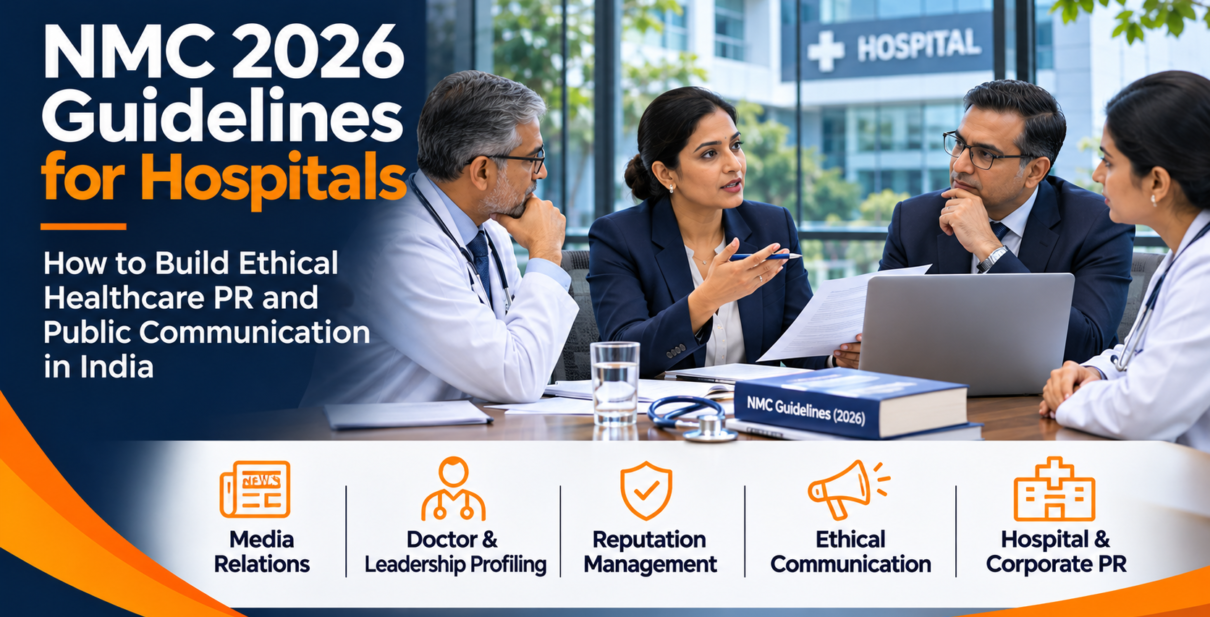
NMC 2026 guidelines for hospitals
Healthcare communication in India is entering a more tightly regulated environment.
Hospitals, medical institutions, and registered medical practitioners communicate with the public through websites, social media, interviews, public health campaigns, digital publications, and other channels.
These communications influence how patients and their families understand medical services, clinical capabilities, professional expertise, and healthcare organizations.
However, public communication in healthcare requires particular care. An unsupported treatment claim, misleading patient testimonial, or exaggerated institutional statement can create reputational and regulatory concerns.
On 6 October 2026, the National Medical Commission (NMC), through its Ethics and Medical Registration Board, issued the Guidelines on Ethical Advertising and Public Communication by Hospitals/Medical Institutions and Registered Medical Practitioners.
The guidelines address truthful communication, patient privacy, medical claims, digital promotion, testimonials, AI-generated content, and the responsibilities of hospitals and their communication partners.
For healthcare organizations, this makes it important to review how public relations, media relations, and digital communication are planned.
A healthcare PR agency in India should understand the difference between communicating verified institutional information and creating promotional claims that may raise ethical concerns.
What are the NMC 2026 guidelines for hospitals on healthcare advertising and Public Communication?
The National Medical Commission issued its public notice on 6 October 2026.
The notice states that the guidelines come into force immediately upon publication by the NMC.
Their stated objectives include:
- Protecting patients from misleading or unsubstantiated medical claims.
- Ensuring healthcare communication is truthful, transparent, and evidence-based.
- Protecting patient privacy and autonomy.
- Preventing direct or indirect solicitation of patients.
- Avoiding commercial promotion that may encourage unnecessary investigations, treatments, or procedures.
- Addressing advertising and promotional communication through digital and emerging technologies.
- Preserving the dignity and integrity of the medical profession.
The guidelines apply to the professional conduct of registered medical practitioners in relation to advertising, publicity, digital communication, and promotional activity.
For hospitals and medical institutions, they must be read alongside the applicable Clinical Establishments Act, relevant rules, or other applicable state legislation. Where an irreconcilable conflict exists, the applicable statutory provisions take precedence.
The guidelines also clarify that the involvement of a digital platform, advertising agency, influencer, or another intermediary does not automatically remove the responsibility of the RMP or institution for communication it authorized, commissioned, sponsored, adopted, or knowingly permitted.
Source: National Medical Commission, Public Notice No. R-13014/01/2024-Ethics, dated 6 October 2026.
Why These Guidelines Matter for Hospital PR in India
Hospitals communicate with several audiences.
Patients want factual information about departments, facilities, services, and available doctors. Employees need clear institutional updates. Healthcare professionals may want to discuss research and clinical developments. Journalists may seek expert explanations of public health issues.
Hospitals also need to communicate corporate developments such as
- Opening a new facility.
- Establishing a new department.
- Introducing medical equipment.
- Expanding emergency services.
- Receiving institutional accreditation.
- Launching healthcare technology.
- Appointing senior management.
- Participating in public health initiatives.
- Announcing healthcare partnerships.
The challenge is to communicate these developments accurately without turning factual information into misleading or inappropriate promotion.
A healthcare PR strategy should therefore consider editorial relevance, evidence, patient privacy, spokesperson expertise, and applicable communication requirements before a campaign begins.
7 NMC Communication Areas Hospitals Should Review
1. Medical and Institutional Claims
Hospitals should review the language used across websites, advertisements, brochures, social media accounts, and other public communication.
The guidelines address exaggerated, misleading and unsubstantiated statements.
They specifically identify superiority claims such as:
- Best hospital.
- No. 1 specialist.
- Most trusted.
- Leading.
- Number one.
- Unmatched.
Such claims cannot be used casually. The guidelines state that comparative claims must be objectively verifiable, based on transparent and independently ascertainable methodology, and otherwise permitted under applicable law.
Similarly, claims of guaranteed cures, guaranteed treatment outcomes or exaggerated clinical success require particular scrutiny and are restricted under the guidelines.
PR recommendation: Develop a documented claim-review process. Check the source, supporting evidence, methodology, relevant dates and approval for each clinical or institutional claim before publication.
2. Patient Testimonials, Reviews and Endorsements
Patient stories can contain sensitive personal and medical information.
The guidelines prohibit soliciting, purchasing, procuring or manipulating fake, paid or misleading patient reviews, ratings, testimonials, endorsements and recommendations for promoting medical services.
They also state that patient consent alone does not make an otherwise prohibited testimonial, endorsement, promotional patient story, before-and-after depiction or success claim permissible.
Hospitals should review:
- Patient photographs.
- Treatment videos.
- Patient interviews.
- Testimonials.
- Before-and-after content.
- Patient success stories.
- Online reviews used in promotional communication.
Where disclosure of patient information is legally permitted, applicable consent and privacy safeguards must be followed.
PR recommendation: Use institutional developments, approved research, verified clinical information and expert commentary as communication subjects rather than relying on patient testimonials to promote services.
3. Digital Marketing and Social Media Communication
The guidelines cover promotional communication across digital and emerging technologies.
A communication channel does not automatically make a promotional claim acceptable.
Hospitals and medical institutions should review:
- Instagram posts and reels.
- Facebook posts.
- LinkedIn corporate announcements.
- YouTube videos.
- Website banners.
- Sponsored content.
- Influencer-led communication.
- Digital advertisements.
- Promotional podcasts.
- WhatsApp communication.
The underlying content and purpose matter.
A hospital should distinguish factual institutional information and educational public communication from promotion that solicits patients, creates unnecessary demand or makes unsubstantiated claims.
PR recommendation: Create a content approval process involving the communications team, relevant medical experts and legal or compliance representatives.
4. AI-Generated and AI-Assisted Healthcare Content
The NMC guidelines specifically address AI-generated promotional content.
They prohibit AI-generated promotional campaigns for the furtherance of commercial interest.
They also prohibit using AI-generated or AI-assisted content to create misleading, deceptive or unverifiable representations concerning diagnosis, treatment, clinical outcomes, professional qualifications, patient experiences or healthcare services.
The guidelines further address:
- Synthetic patient images.
- Manipulated patient testimonials.
- Synthetic patient or doctor voices.
- Fabricated clinical outcomes.
- AI-generated endorsements.
- Disclosure of AI-generated or materially AI-altered content where its artificial nature may be material to the audience.
- Protection of patient information used as input into AI systems.
The guidelines also prescribe source marking for AI-generated promotional content that otherwise conforms to the applicable provisions.
PR recommendation: Healthcare brands should establish clear controls for AI-assisted writing, visual generation, content verification and patient-data handling. Creative efficiency should never replace medical review or regulatory assessment.
5. Doctor Profiling and Leadership Communication
Doctors and medical professionals may have valuable experience to share through health education, academic discussions and expert communication.
However, professional expertise should not be converted into promotional patient solicitation.
The guidelines permit medical practitioners to participate in health awareness programmes, public health campaigns, academic discussions and educational content, provided these activities do not promote personal practice, solicit patients or get monetised through promotional marketing.
They also permit certain public health lectures and talks in a doctor’s own name and designation without promoting the employer organisation.
Healthcare organisations should review the distinction between educational expertise and individual professional promotion.
PR recommendation: Develop evidence-based public health commentary, suitable academic communication and factual institutional updates with appropriate medical and regulatory review.
6. Influencer and Third-Party Communication
Healthcare organisations frequently work with external communication partners, content creators, advertising agencies and digital platforms.
The NMC guidelines make clear that a third party cannot be used to do indirectly what the doctor or institution is prohibited from doing directly.
They also address payments and consideration linked to procuring or referring individual patients.
A hospital should therefore review its contracts and campaign arrangements for:
- Influencer partnerships.
- Sponsored posts.
- Paid testimonials.
- Referral campaigns.
- Patient acquisition arrangements.
- Celebrity endorsements.
- Third-party social media promotions.
PR recommendation: Establish written content responsibilities, approval arrangements, disclosures and review procedures for external communication partners.
7. Factual Institutional Communication
The guidelines do permit hospitals and medical institutions to disseminate factual, objective and verifiable information about institutional matters.
Examples include:
- Hospital name and location.
- Contact details.
- Departments.
- Facilities and equipment.
- Medical services.
- Emergency services.
- Accreditation status.
- Applicable charges.
- Other institutional information permitted by applicable law.
This distinction is important for hospital corporate communications.
A hospital may need to inform the public about its facilities, departments, service availability and institutional developments without relying on unsupported superiority claims or promotional treatment guarantees.
PR recommendation: Build public communication around verified institutional facts, relevant healthcare developments and clear information.
Healthcare PR vs Healthcare Advertising: What Is the Difference?
Healthcare organisations should understand that PR and advertising are different communication approaches, but simply labelling content as PR does not automatically remove regulatory considerations.
The NMC guidelines define advertising broadly to include communication, publicity, announcements, representations and dissemination of information in any medium when it directly or indirectly solicits or promotes the professional services, reputation, skills, qualifications, facilities or commercial healthcare services of an RMP or institution.
Consider the following distinction:
| Communication activity | Strategic PR consideration |
|---|---|
| Reporting a verified new hospital facility | Communicate factual institutional information |
| Medical expert discussing a public health issue | Establish educational purpose and comply with professional requirements |
| A press release announcing a new department | Verify facts, scope and approved information |
| A doctor claiming to be the best in a speciality | Avoid unsupported superiority claims |
| Publishing a patient’s treatment testimonial | Review the restrictions on testimonials and patient information |
| Promoting guaranteed treatment results | Avoid cure guarantees and unsupported outcomes |
| AI-generated patient success imagery | Avoid synthetic patient representations and prohibited promotional use |
A company should not assume that a press release, interview or third-party publication is automatically outside the guidelines. The purpose, wording, content and applicable legal requirements should be assessed for each communication.
How Hospitals Can Build a Better Healthcare PR Strategy
A structured healthcare communications programme can help organisations manage their public information, institutional reputation and media engagement.
Step 1: Conduct a Healthcare Communication Review
Start by identifying where the institution communicates publicly.
Review:
- Official website.
- Hospital service pages.
- Doctor and leadership profiles.
- Social media accounts.
- Press releases.
- Media interviews.
- Sponsored communication.
- Influencer arrangements.
- Public information brochures.
- Existing corporate announcements.
This creates an inventory of the content requiring further review.
Step 2: Develop an Evidence-Based Message Framework
Establish the institutional information that can be communicated and the supporting material behind it.
For example, a new hospital facility announcement may include the location, departments, available equipment, service information and accreditation details where factually established and permitted.
Each claim should have an owner and an approval record.
Step 3: Develop a Media Relations Strategy
Healthcare media relations should prioritise story relevance and credible expertise.
Potential communication subjects include:
- Healthcare infrastructure.
- Medical technology.
- Hospital expansions.
- Institutional research.
- Public health initiatives.
- Healthcare industry developments.
- Expert commentary.
- Leadership perspectives.
- HealthTech innovation.
Journalists should receive factual material and access to appropriately qualified experts. PR agencies should never promise favourable editorial coverage.
Step 4: Coordinate Medical, Legal and Communication Teams
The communication team should not independently approve clinical claims.
A structured workflow should involve:
- Communications team drafts the material.
- Relevant medical expert verifies clinical facts.
- Legal or compliance team reviews applicable requirements.
- Authorised management approves publication.
- Communications team publishes and monitors the approved content.
This arrangement creates clear accountability.
Step 5: Monitor Public Communication
Review website content, published stories, social media and external communication periodically.
Record corrections, approval changes, new developments and content that needs updating.
A healthcare communication programme should be reviewed whenever relevant regulations, services, clinical capabilities or organisational responsibilities change.
How to Choose a Healthcare PR Agency in India
Before appointing a healthcare PR agency, ask the following questions.
Does the agency understand healthcare communication?
It should understand the differences between hospital PR, HealthTech PR, pharma communication, medical technology and public health communication.
Does it understand the NMC guidelines?
Ask how it approaches claim verification, patient privacy, testimonials, doctor positioning, AI-generated content and third-party communication.
Can it work with your medical and legal teams?
The agency should understand that medical validation and legal approvals are essential parts of the communication process.
Does it have media relations capabilities?
Review its knowledge of healthcare publications, business media, technology publications and relevant regional outlets.
Can it support reputation and crisis communication?
Healthcare organisations need communication support for public announcements, sensitive issues, media enquiries and institutional reputation matters.
Does it provide transparent reporting?
Ask for reporting on relevant media coverage, message accuracy, expert visibility, referral traffic and business-aligned communication outcomes.
Is the commercial scope clearly defined?
Confirm the content deliverables, media outreach, leadership communication, approval responsibilities, reporting frequency and fees.
How AdventPR Can Support Healthcare Communications
AdventPR already works across healthcare PR, media relations, thought leadership, Digital PR, reputation management and crisis communication.
Its existing Healthcare PR offering covers communication requirements for hospitals, HealthTech companies, pharmaceutical organisations, MedTech businesses and healthcare leaders.
Depending on the organisation’s requirements, a healthcare communication programme can include:
- Healthcare media relations.
- Hospital PR.
- Healthcare corporate communications.
- Medical expert and leadership positioning.
- Healthcare thought leadership.
- Digital PR.
- Corporate reputation management.
- Crisis communication.
- Healthcare content development.
- Industry media outreach.
The communication approach should begin with the institution’s business objectives, factual information, audiences and relevant regulatory considerations.
AdventPR can coordinate with the client’s medical, legal and compliance teams to develop a communication plan. Regulatory interpretation and legal compliance approval should remain with appropriately qualified advisers.
Looking for a Healthcare PR Agency in India?
Hospitals and healthcare organisations need communication that is factual, relevant, transparent and appropriate for their audiences.
If your hospital is reviewing its public communication, planning a new facility announcement, strengthening healthcare media visibility or developing a corporate PR programme, AdventPR can discuss your requirements.
Start with a Healthcare PR and Public Communication Review to identify your current communication priorities, media opportunities, content gaps and suggested next steps.
Advent Public Relations
Website: https://adventpr.com/
Email: info@adventpr.com
Phone: +91 93199 71631
Explore AdventPR’s Healthcare PR Strategy in India, or contact the team to discuss your healthcare communication needs.
Frequently Asked Questions
The National Medical Commission issued guidelines on 6 October 2026 covering ethical advertising and public communication by hospitals, medical institutions and registered medical practitioners. They address factual claims, patient privacy, digital communication, testimonials, AI-generated material and promotional practices.
The guidelines permit hospitals and medical institutions to share factual, objective and verifiable information about their name, location, departments, facilities, equipment, services, emergency services, accreditation status and charges, subject to applicable law. Such communication must not contain prohibited solicitation, misleading claims or guarantees of cure.
The guidelines prohibit RMPs from requesting or sharing patient testimonials, endorsements, recommendations or reviews for professional promotion on social media. They also prohibit fake, paid or misleading patient testimonials and related promotional material.
Hospitals and doctors must ensure that external agencies, influencers and other intermediaries are not used to carry out practices prohibited directly. Communication arrangements also need to be reviewed for patient solicitation, endorsements, referrals and applicable disclosure requirements.
The NMC guidelines prohibit AI-generated promotional campaigns for the furtherance of commercial interest. They also prohibit misleading AI-generated or AI-assisted healthcare representations, synthetic patient endorsements and manipulated clinical outcomes. Applicable source marking and disclosure requirements must be considered.
A PR agency can support healthcare communication through media research, factual story development, expert interviews, corporate announcements, thought leadership and reputation management, subject to applicable medical, privacy, professional and advertising requirements.
Hospitals should review claims, patient information, doctor profiles, websites, social media, sponsored content, influencer arrangements, external agencies, AI-generated content and approval workflows.
AdventPR has an existing Healthcare PR offering covering hospitals, HealthTech, pharma, MedTech, media relations, thought leadership and reputation management. Healthcare organisations can contact the team to discuss the required campaign scope and deliverables.