



- August 24, 2026
- by adventpr
- AI Technology, Branding
- 349 Views
What Google AI Overviews Mean for Brand Reputation
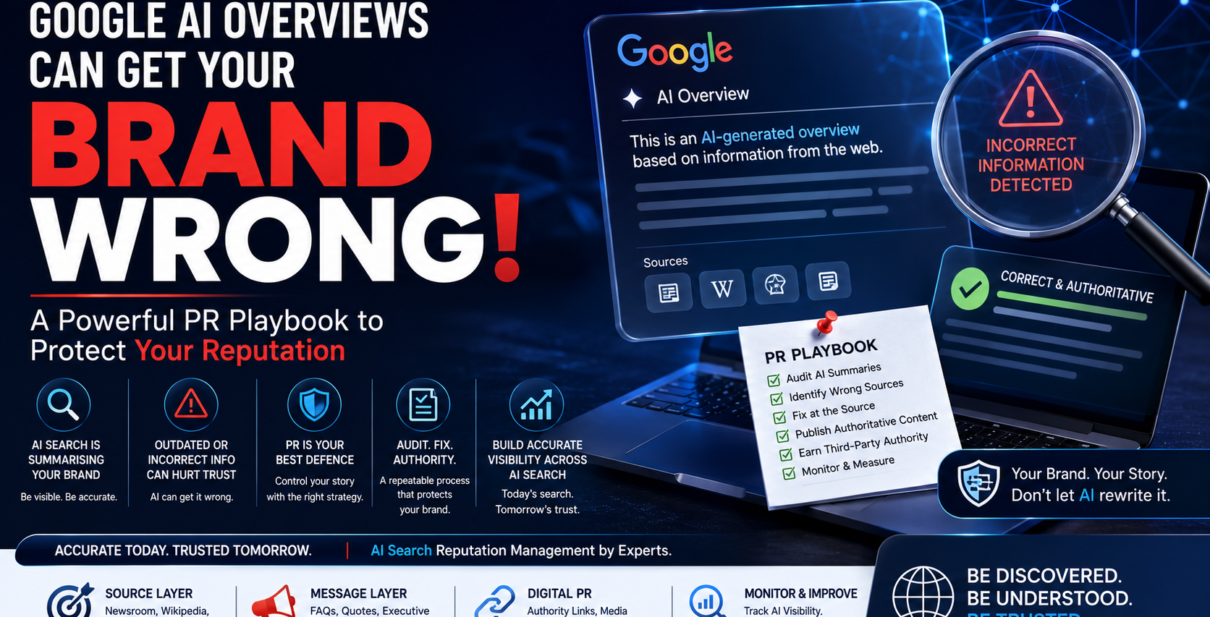
Google AI Overviews have changed how users consume information from search. Instead of simply viewing a list of links, users may receive an AI-generated summary with supporting web links. Google itself states that AI Overviews can contain mistakes and recommends checking important information against multiple sources.
For businesses, this creates a new AI search reputation risk. A company can have accurate information on its website yet still encounter an outdated, incomplete, or misleading representation within an AI-generated answer.
How Can Google Summarise a Company Incorrectly?
AI-generated search answers can draw on information from multiple sources. This means an outdated article, inconsistent business profile, unclear entity relationship, or inaccurate third-party page can become part of the information ecosystem surrounding a brand.
Google’s documentation explains that AI Overviews use generative AI to provide snapshots from information available through Search, while Google’s broader Search systems remain important to these experiences.
The practical PR lesson is simple: your website is not your only reputation asset.
Six Common AI Search Reputation Failure Modes
Outdated Media Coverage
Old descriptions, former leadership information, or outdated company positioning may continue to appear in web sources.
Inconsistent Brand Entities
Different company names, descriptions, locations, or executive information can make it harder for search systems to connect the correct information.
Weak Source Quality
When authoritative first-party information is limited, users may encounter information from sources that do not accurately represent the company.
Review and Reputation Signals
Customer reviews and third-party discussions can influence the wider reputation ecosystem surrounding a brand.
Entity Confusion
Businesses with similar names, executives, or products can potentially be confused within complex search contexts.
Message Gaps
When a company does not clearly publish answers to common questions, external sources may fill those gaps.
The AI Search Reputation Audit: 30 Minutes to 30 Days
A practical Generative Engine Optimization audit should begin with the questions your customers, investors and journalists actually ask.
Search your company name, executives, products and major services. Test branded questions as well as non branded queries. Record what Google AI Overviews displays, which sources are cited and whether the claims are accurate.
Then categorize every issue into:
Correct → Outdated → Incomplete → Misleading → Source Problem → Entity Problem
This creates a defensible AI reputation management workflow rather than relying on occasional manual searches.
Fix the Source Layer
The first correction priority should be the information ecosystem.
Review your website, newsroom, executive profiles, Google Business information, industry directories and authoritative third party references. Use consistent organization and person information and implement appropriate structured data.
Google says structured data helps it understand page content and the entities represented within it. Google also recommends complete and accurate structured data rather than adding unnecessary or inaccurate markup.
However, structured data should be treated as a supporting signal, not a mechanism that guarantees inclusion in AI Overviews.
Fix the Message Layer With Authoritative Content
Next, strengthen the content that explains your brand.
Publish clear executive statements, FAQs, service explanations, expert articles, case studies, and original research. Build a visible source of truth for the information that matters most.
Then use digital PR to strengthen third-party authority through credible media coverage, expert commentary, interviews, and relevant industry publications.
When Should PR Involve Legal or Platform Feedback?
Not every incorrect AI statement requires legal escalation. Start by documenting the claim, identifying the cited source and correcting the underlying source where possible.
Google provides feedback mechanisms for AI Overviews. Users can mark an overview as unhelpful or report a problem, including issues with accuracy.
Legal or regulatory teams should become involved when inaccurate AI-generated information creates material risks involving defamation, regulated disclosures, consumer protection, privacy, or other legal obligations.
Why Advent PR Is Building AI Search Reputation Management
At Advent PR, we connect AI search optimization, digital PR, reputation management, media relations, entity optimization, executive thought leadership, and crisis communication into an ongoing correction loop.
The framework is:
Detect → Verify → Identify Source → Correct → Publish Source of Truth → Earn Third-Party Authority → Monitor Again
The objective is not to manipulate Google AI Overviews. It is to make the web ecosystem around your brand more accurate, authoritative and consistent.
In the AI search era, reputation management is no longer only about what appears in Google’s blue links.
It is also about what the machine says when someone asks about your brand.
Frequently Asked Questions
Google AI Overviews provide AI-generated summaries within Google Search and can include links to supporting web information. Because Google acknowledges that these responses can contain mistakes, inaccurate summaries can create a brand reputation risk.
Potential causes can include outdated or inconsistent information across the web, unclear entity relationships, incomplete first party content or inaccurate third party sources. The correct response is to identify the information source and strengthen the authoritative information available about the brand.
PR teams should verify the claim, identify the cited or contributing source, correct inaccurate source material where possible, publish authoritative source of truth content and use Google’s available feedback mechanisms when an AI Overview is inaccurate.
Media coverage can contribute to the broader information ecosystem surrounding a brand. However, there is no guaranteed method for securing inclusion in an AI Overview. The stronger approach is to build credible, relevant and consistent information across authoritative sources.
Entity optimization is the process of making information about an organization, person, product or service consistent and understandable across relevant digital properties. Structured data can provide Google with explicit clues about page content and entities.
There is no general PR control that allows a company to simply delete an AI Overview. Google provides feedback mechanisms for reporting inaccurate or problematic AI responses, while businesses should also work to correct the underlying source information and strengthen authoritative sources.