


- November 10, 2026
- by adventpr
- Uncategorized
- 47 Views
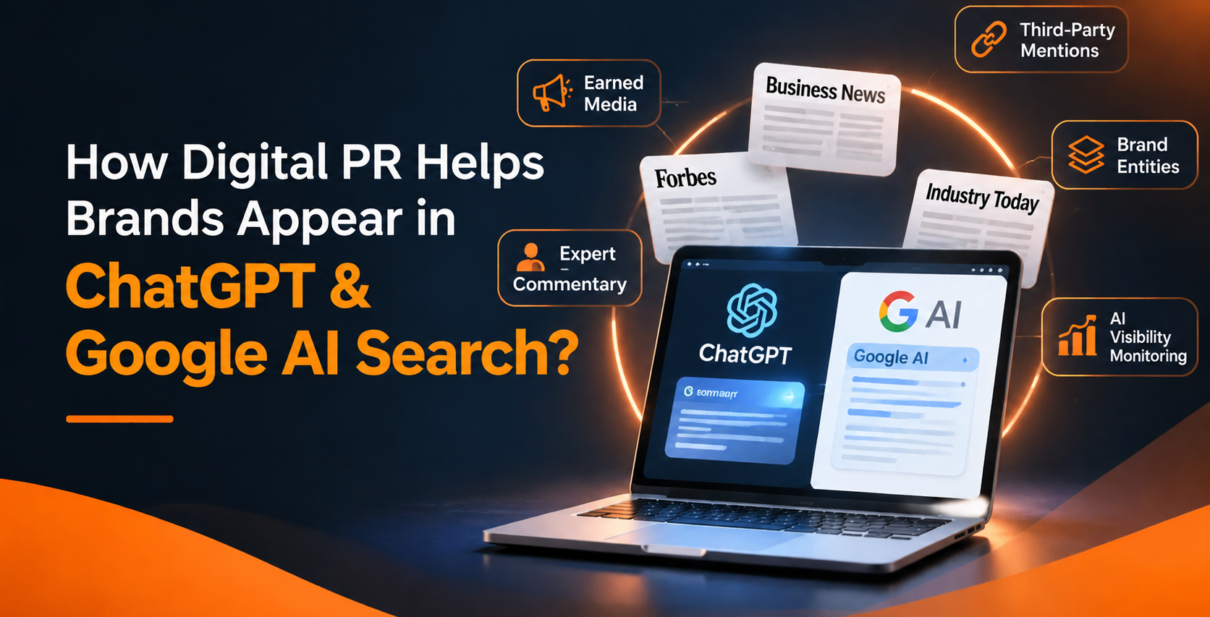
How Digital PR Helps Brands Appear in ChatGPT
When someone asks ChatGPT to recommend a technology company, searches Google for a reliable financial services provider, or uses an AI assistant to compare business solutions, which brands appear in the answer?
For founders and marketing teams, this is becoming an important visibility question.
Traditional SEO focuses on helping websites appear in search engine results. AI-powered search introduces another layer of discovery. Platforms such as ChatGPT Search, Google AI Overviews, Google AI Mode, and Perplexity can summarize information, compare businesses, and provide links to sources that support their answers.
This changes how brands need to approach online visibility.
A company may have a well-designed website, publish blogs regularly, and run digital advertising campaigns, yet still have limited visibility in AI-generated answers. One reason may be that its expertise and reputation are not sufficiently represented across credible independent sources.
This is where digital PR can contribute to generative engine optimization (GEO).
Digital PR helps brands earn relevant media coverage, expert mentions, interviews, industry commentary and other third-party references. These activities can strengthen the information available about a company across the web and support its discoverability in AI-powered search.
What Is AI Search Visibility (How Digital PR Helps Brands Appear in ChatGPT)?
AI search visibility refers to how often and how accurately a brand appears in answers generated by AI-powered search platforms.
For example, a founder might ask:
- Which digital PR agencies work with technology startups in India?
- What should a company consider before hiring a PR agency?
- Which companies provide corporate reputation management services?
- Which brands have expertise in crisis communication?
An AI platform may generate an answer using information from its available search results, indexed webpages and other sources. Depending on the platform and query, it may mention companies, describe their services or link to supporting websites.
There are two important measures of visibility:
Brand mentions: The company is named in an AI-generated response.
Brand citations: A webpage or source associated with the company is linked or referenced as supporting information.
A company can be mentioned without its own website being cited. Similarly, an AI answer can cite an independent publication while discussing a brand.
For marketing teams, both measures matter. Mentions indicate that the brand is part of the conversation. Citations help identify which sources are supporting that visibility.
Why Digital PR Matters for ChatGPT and Google AI Search
AI platforms need information to answer questions about companies, products, services and industries. Their answers can draw on different types of sources, including company websites, news publications, specialist websites, reference platforms and community discussions.
A brand’s own website explains what the company says about itself. Independent coverage can provide additional context about its work, expertise, leadership and market presence.
Digital PR helps create this wider information footprint.
A June 2026 Semrush AI Visibility Index analysis of 126 million US AI search prompts found that AI platforms draw on different combinations of owned websites, publishers, community platforms and other sources. It also identified a distinction between brand mentions and citations.
For brands, the practical lesson is to build visibility across relevant sources rather than depend entirely on their own website.
1. Earned Media Creates Independent Brand References
Earned media is publicity a company receives through editorial coverage, interviews, expert contributions, news features and other independent publications.
Unlike paid advertising, earned media coverage is editorially selected and published by an external platform.
Examples include:
- A founder interview in a business publication.
- An expert opinion quoted in an industry news article.
- A company announcement covered by relevant media outlets.
- A technology leader contributing commentary on an industry development.
- A specialist publication discussing a company’s work or expertise.
These references can help establish what a company does, which industry it operates in and what its leadership team understands.
For example, imagine a SaaS company that wants to be recognised for cybersecurity solutions.
Its website may describe its services. However, if its founder also contributes expert commentary to cybersecurity publications, participates in industry interviews and is quoted in relevant business coverage, more independent information becomes available about the company’s expertise.
That wider presence can support brand discovery and provide useful context for AI-powered search systems.
Earned media does not guarantee a ChatGPT mention or Google AI Overview placement. Its value lies in building relevant, credible and discoverable information about the brand.
2. Credible Third-Party Mentions Strengthen Brand Understanding
AI search visibility is influenced by the information available across the web.
When a company appears consistently in relevant, credible publications, it becomes easier for people and information systems to find references connecting that company with its industry and expertise.
Consider a management consulting firm.
Its website may describe its services as business strategy, leadership consulting and operational transformation. If independent business publications also discuss its founder’s expertise in these areas, the brand has additional references supporting its professional positioning.
However, the quality and relevance of mentions matter.
A few meaningful references in respected industry publications may be more useful for reputation-building than dozens of unrelated directory listings or low-quality guest posts.
Brands should prioritise:
- Relevant business and industry publications.
- Independent editorial coverage.
- Accurate company and founder descriptions.
- Consistent service and industry terminology.
- Genuine expert contributions.
- Publications that are accessible to search engines.
Digital PR should focus on earning coverage that makes sense for the company’s audience and expertise.
3. Expert Commentary Gives Founders a Stronger Voice
Founders, CEOs and senior executives have direct experience with business decisions, market changes, customer problems and industry developments.
That knowledge can become a valuable source of media content.
Expert commentary allows business leaders to contribute informed opinions to ongoing industry conversations.
For example:
- A fintech founder can explain changes in digital payments.
- A healthcare executive can discuss technology adoption in healthcare operations.
- A cybersecurity leader can comment on emerging business security risks.
- A marketing leader can explain changes in customer acquisition.
- A manufacturing CEO can discuss supply chain developments.
When journalists include these perspectives in relevant articles, the executive receives independent visibility associated with a specific subject.
This can help connect the founder’s name with their area of expertise.
For better results, companies should develop a clear spokesperson strategy. Identify the subjects each leader can comment on, prepare accurate supporting information and respond to relevant media opportunities with useful insights.
A generic company announcement rarely provides the same depth of expertise as a well-supported expert opinion.
4. Brand Entities Help AI Systems Understand Who You Are
Entity SEO is an important part of building a clear online identity.
An entity is a distinct, identifiable person, organisation, product, place or concept. Search systems use information from different sources to understand relationships between entities.
For a business, its digital identity may include:
- Official company name.
- Website and domain.
- Founders and senior leadership.
- Headquarters and business locations.
- Products and services.
- Industry and areas of expertise.
- Official social media profiles.
- Media coverage and professional references.
Suppose a company uses different descriptions across its website, LinkedIn page, press releases and media interviews. Search systems and readers may find it harder to understand whether those references describe the same organisation and what the company actually does.
A consistent identity helps reduce that confusion.
Brands should maintain accurate company information across their website, business profiles, press materials and relevant third-party platforms.
Structured data can also help search engines interpret information. Depending on the page, relevant Schema.org types may include Organization, Person, Article, NewsArticle and Service.
Structured data should accurately describe visible page content. Adding schema does not guarantee AI citations or special search placement.
The objective is straightforward: make it clear who the company is, what it does, who leads it and which subjects it has expertise in.
5. Digital PR and GEO Work Better as Connected Activities
Generative Engine Optimization (GEO) refers to practices aimed at improving a brand’s visibility and representation in generative AI experiences.
Digital PR can contribute to GEO by strengthening the brand’s external presence. SEO and content strategy support the same goal by making the company’s own information useful, accessible and technically discoverable.
These activities should work together.
Digital PR: Earn relevant media coverage, interviews, expert mentions and independent references.
SEO: Improve website structure, technical accessibility, internal linking, search intent alignment and organic visibility.
Content marketing: Publish useful, original information that answers audience questions and demonstrates real expertise.
Entity SEO: Maintain consistent and accurate information about the organisation, founders and services.
GEO monitoring: Track brand mentions, citations, source references and the accuracy of AI-generated descriptions.
Google’s guidance for AI features continues to emphasise established SEO fundamentals, useful original content and technical eligibility for Search. OpenAI also advises website owners to allow OAI-SearchBot if they want their pages to be eligible for ChatGPT Search results.
There is no separate technical trick that guarantees inclusion. A connected strategy gives brands a stronger foundation for discovery.
6. How to Monitor Your Brand’s Visibility in ChatGPT and Google AI Search
AI visibility should be measured regularly rather than judged from one search.
The same brand may appear in one AI response and be absent from another because the wording, location, date, platform and underlying sources can change.
Marketing teams can establish a repeatable monitoring process.
Step 1: Create a list of target prompts
Prepare questions that potential customers might ask.
For example:
- Which PR agencies in India work with startups?
- How can a company manage online reputation?
- Which agencies provide Digital PR services in India?
- How can a founder build visibility in business media?
- What should a company look for when choosing a PR agency?
Include branded searches, non-branded industry searches, service comparisons and location-based questions where relevant.
Step 2: Test multiple AI platforms
Run the same prompts across:
- ChatGPT Search.
- Google AI Overviews and AI Mode.
- Perplexity.
- Gemini.
Record whether the company appears, whether its website is cited and which other sources are referenced.
Step 3: Track brand mentions and citations separately
Create two separate records:
- Brand mention rate: How frequently the brand appears in the tested responses.
- Citation frequency: How frequently the brand’s website or other associated sources are cited.
Also record competitor mentions and the sources supporting their visibility.
Step 4: Review brand accuracy and context
Check how AI platforms describe the company.
Are its services correct? Is the founder’s role accurate? Is the business associated with the right industry? Are outdated details appearing?
Incorrect information should be addressed through accurate updates on owned channels and relevant external sources.
Step 5: Measure referral traffic and business outcomes
Use website analytics to monitor traffic from AI platforms. OpenAI documents the use of the utm_source=chatgpt.com referral parameter for ChatGPT Search traffic.
Track:
- AI-referred website sessions.
- Landing pages receiving AI traffic.
- Enquiry and contact-form submissions.
- Qualified leads from AI-referred sessions.
- Conversions and pipeline influence.
A rise in mentions is useful to observe, but qualified enquiries and business outcomes provide a clearer view of commercial value.
7. What Should Brands Do in the Next 90 Days?
Companies looking to improve AI search visibility can start with a focused 90-day programme.
Days 1–30: Establish the baseline
- Audit the website’s technical SEO and indexability.
- Check whether OAI-SearchBot is blocked in robots.txt.
- Review Google Search Console settings for generative AI features.
- Audit company, founder and service information.
- Create a list of 20–30 relevant AI search prompts.
- Record existing mentions, citations and competitor visibility.
Days 31–60: Build credible external visibility
- Identify relevant business and industry publications.
- Develop founder and executive commentary topics.
- Pitch original insights and newsworthy company developments.
- Publish expert-led articles and useful website resources.
- Correct inconsistent company descriptions across important profiles.
- Strengthen internal links between service pages, case studies and expert content.
Days 61–90: Measure and refine
- Repeat the original AI prompt tests.
- Compare brand mentions and citations.
- Identify which publications and webpages appear most frequently.
- Review competitor coverage and content gaps.
- Assess AI referral traffic and enquiries.
- Refine media outreach based on relevance and measurable outcomes.
This programme creates a practical starting point. Results will vary by industry, competition, platform and the quality of the information available online.
Common Mistakes Brands Should Avoid
Trying to influence AI search can lead to tactics that create noise rather than meaningful authority.
Avoid these mistakes:
Publishing large volumes of generic AI-written articles: Repetitive content does not automatically improve search visibility. Focus on original insights, useful evidence and genuine expertise.
Buying irrelevant backlinks or mass-produced media placements: A large number of low-quality mentions does not establish a credible reputation.
Using inconsistent company descriptions: Keep official names, services, leadership information and business details accurate.
Treating every AI platform as identical: Different platforms may retrieve and cite different sources.
Measuring only rankings or impressions: Include brand mentions, citations, referral traffic, qualified leads and business outcomes.
Expecting guaranteed AI placements: No PR agency can guarantee that ChatGPT or Google will mention a particular company in every relevant answer.
Final Thoughts: Digital PR Is Becoming Part of AI Search Strategy
The way people discover businesses is changing. Search engines and AI assistants are becoming important starting points for research, comparison and decision-making.
Brands need to make their expertise visible across the web. Their websites should explain their services clearly, their content should answer real questions, and their external presence should include credible references from relevant publications and industry sources.
Digital PR helps build that external presence through earned media, expert commentary, interviews and independent brand mentions.
When combined with technical SEO, useful content and consistent entity information, it can support a broader AI search visibility strategy.
For founders and marketing teams, the question is worth asking: when a potential customer asks ChatGPT or Google AI to recommend a company in your industry, is there enough credible information about your brand for it to be part of that conversation?
Want to strengthen your brand’s visibility across search engines and AI-powered platforms?
AdventPR helps businesses build media visibility, brand authority and digital presence through strategic PR, Digital PR and reputation management.
Explore AdventPR’s Digital PR services and discuss an AI search visibility strategy for your business.
Frequently Asked Questions
Digital PR can support brand visibility by generating relevant media coverage, expert commentary and independent references. These sources can provide additional information about a company. However, no Digital PR campaign can guarantee that ChatGPT will mention or cite a brand.
Earned media creates independent references to a company, its services and its leadership. Relevant editorial coverage can help expand the information available about a brand and support its discoverability across search and AI-powered experiences.
SEO focuses on improving a website’s visibility in search engine results. GEO focuses on how brands and their information appear in generative AI answers. Both rely on useful content, discoverability, relevance and trustworthy information.
Google AI features can surface links to relevant webpages from its Search index. Independent media coverage may be among the information available to search systems, provided the content is accessible and eligible. Inclusion is not guaranteed.
Create a list of relevant branded and non-branded questions and test them regularly in ChatGPT Search. Record brand mentions, citations, linked sources and competitor appearances. Use a consistent set of prompts so results can be compared over time.
There is no special schema markup that guarantees inclusion in AI-generated answers. Use accurate structured data where appropriate, maintain accessible website content and follow established technical SEO practices.
Yes. Startups can use founder interviews, expert commentary, original research and relevant industry coverage to build a stronger public information footprint. The focus should be on relevant, credible exposure rather than simply increasing the number of mentions.