



- October 9, 2026
- by adventpr
- Agritech, AI Technology, Industry insights, Public Relations, Technology
- 30 Views
Future Of AgriTech In India
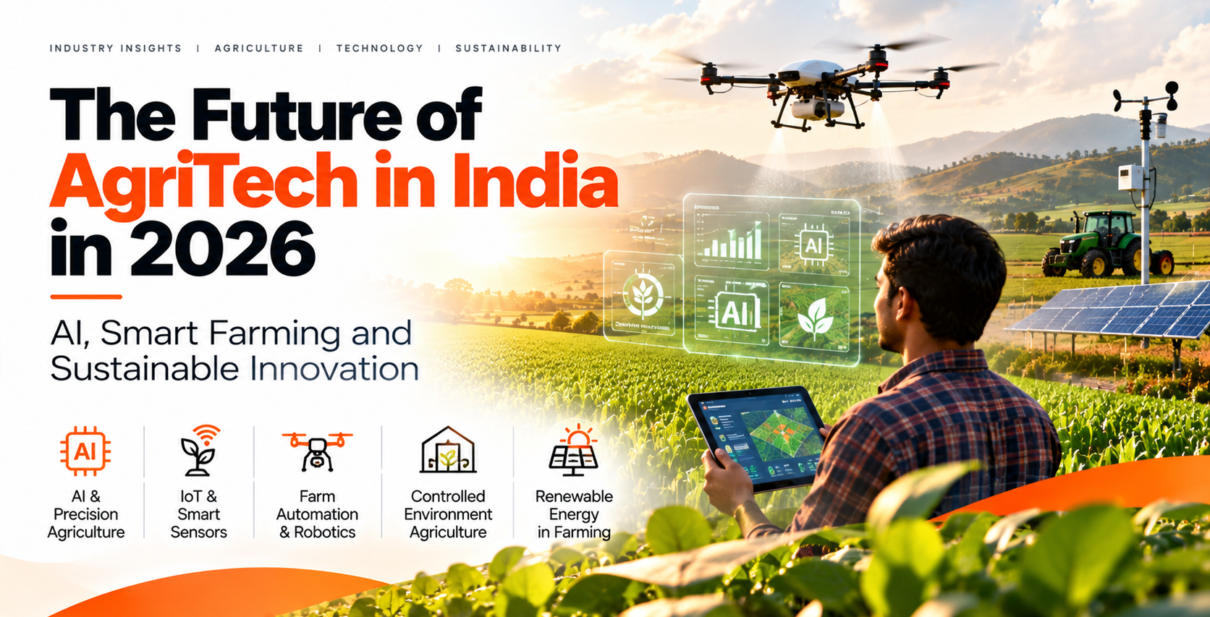
Agriculture is entering a new technological phase. Artificial intelligence, connected sensors, agricultural drones, automated machinery, and renewable energy solutions are creating new possibilities for farming, resource management, and agricultural businesses.
In India, this transformation is supported by research and public initiatives. In August 2026, the Ministry of Agriculture and Farmers Welfare highlighted the use of artificial intelligence, Internet of Things sensors, robotics, drones, remote sensing, and automation across agricultural operations.
For AgriTech startups, established agricultural companies, and investors, the opportunity extends beyond developing new technology. The challenge is making these solutions affordable, practical, trusted, and relevant to the people who use them.
Future Of AgriTech In India
1. AI and Precision Agriculture
Artificial intelligence and precision agriculture are helping agriculture businesses explore more data-informed decisions.
Satellite imagery, crop monitoring systems, weather information, and machine learning models can support crop health assessment, pest detection, irrigation planning and yield estimation. The Indian Council of Agricultural Research is developing precision agriculture capabilities involving sensors, remote sensing, drones, AI and information technologies across different agricultural applications.
For AgriTech companies, the opportunity lies in demonstrating how these tools perform under actual farming conditions. Claims about improved yields, lower costs or resource savings should be supported by reliable field data rather than broad promises.
2. IoT and Smart Farming Sensors
Connected sensors can monitor soil moisture, temperature, water conditions, and other variables relevant to agricultural operations.
When combined with digital platforms, this information can support irrigation scheduling, controlled environment farming, and more informed resource management.
However, sensor technology is useful only when farmers can understand and act on its information. Connectivity, installation costs, maintenance, and technical support can affect adoption.
AgriTech businesses should therefore communicate not only what their sensors measure but also how the information helps users make practical decisions.
3. Farm Automation, Drones, and Robotics
Agricultural drones and automated machinery are opening new possibilities for crop monitoring, precision spraying, and farm operations.
India’s agricultural mechanization initiatives also support equipment access, demonstrations, training, and capacity building.
These technologies can help address specific operational challenges, but their suitability varies by crop, farm size, terrain, regulation and cost.
Companies should focus on demonstrated applications, operating requirements, and measurable benefits. Clear communication about limitations is just as important as explaining innovation.
4. Controlled Environment Agriculture
Hydroponics, aquaponics, vertical farming and greenhouse technologies offer alternative ways to manage crop growing conditions.
These systems can support more controlled production environments, particularly for selected high-value crops. Their commercial viability, however, depends on factors such as energy consumption, equipment investment, crop selection, operating expertise, and market demand.
The strongest AgriTech businesses will explain where these models make sense, what resources they require and which economic conditions influence their success.
5. Renewable Energy in Farming
Solar powered irrigation, biogas, agricultural waste-to-energy systems, and agrivoltaics are expanding the discussion around agriculture and energy.
These approaches can create opportunities for agricultural enterprises seeking to manage energy requirements and explore more sustainable operations.
Their actual benefits depend on installation costs, local conditions, maintenance, energy requirements, and the suitability of the application. Businesses should use credible evidence when communicating environmental or financial outcomes.
The Challenges Between Innovation and Adoption
Technology availability does not automatically produce widespread adoption.
Affordability, infrastructure, digital literacy, access to financing, after-sales service, and confidence in new solutions can all affect whether farmers and agricultural businesses adopt a product.
India’s public agricultural research efforts increasingly combine technology development with demonstrations, training, and digital advisory services, reflecting the importance of implementation alongside innovation.
For AgriTech startups, this means product development and customer education must evolve together. Technology companies need to explain how a solution works, who it serves, what evidence supports its benefits, and what users should realistically expect.
Why Credible Communication Matters for AgriTech
Agricultural technology companies often communicate complex innovations to audiences with very different priorities. Farmers may care about practical utility and cost. Investors may examine scalability and business models. Distributors may focus on market demand, while journalists may look for industry relevance and evidence.
Strategic public relations can help bridge these perspectives.
Advent PR can support AgriTech businesses through media relations, digital PR, founder thought leadership, product announcements, industry commentary, and reputation management. Its agriculture communications approach connects agricultural innovation with relevant stories for the media, business stakeholders, and wider agricultural ecosystem.
The objective is not to exaggerate what technology can achieve. It is to make innovation understandable and communicate its demonstrated value.
The Future Belongs to Useful, Trusted Innovation
The future of AgriTech in India will depend on more than artificial intelligence or advanced machinery. It will also depend on adoption, affordability, infrastructure, operational support and evidence that solutions work in real settings.
For agricultural businesses, the challenge is therefore twofold: develop technology that addresses genuine problems and communicate its value responsibly.
The strongest AgriTech brands will be those that combine meaningful innovation with credible evidence, practical education, and stakeholder trust.
For Advent PR, this creates an opportunity to help agricultural technology companies translate innovation into clear stories that strengthen industry understanding, media visibility, and long-term brand authority.
Frequently Asked Questions
Major AgriTech trends include AI driven precision agriculture, IoT sensors, agricultural drones, farm automation, controlled environment agriculture and renewable energy applications. Their adoption varies according to cost, infrastructure, crop requirements and operational suitability.
AI can support crop monitoring, agricultural advisory services, production forecasting, pest identification and resource management. Its usefulness depends on data quality, local validation and whether the resulting recommendations are practical for farmers.
Precision agriculture uses technologies such as sensors, satellite imagery, remote sensing, drones and data analysis to monitor agricultural conditions and support more targeted management of crops, soil, water and other resources.
IoT sensors collect information such as soil moisture, temperature and water conditions. When integrated with digital systems, this information can help farmers monitor conditions and make more informed decisions about irrigation and other farming activities.
Common challenges include technology costs, connectivity, limited technical support, access to finance, digital literacy, maintenance requirements and the need to demonstrate reliable benefits under local farming conditions.
AgriTech companies can strengthen visibility through credible Media Relations, expert commentary, field demonstrations, research based content, founder Thought Leadership, Digital PR and transparent communication of verified outcomes. These activities can help explain complex technology to farmers, investors, partners and industry stakeholders.