



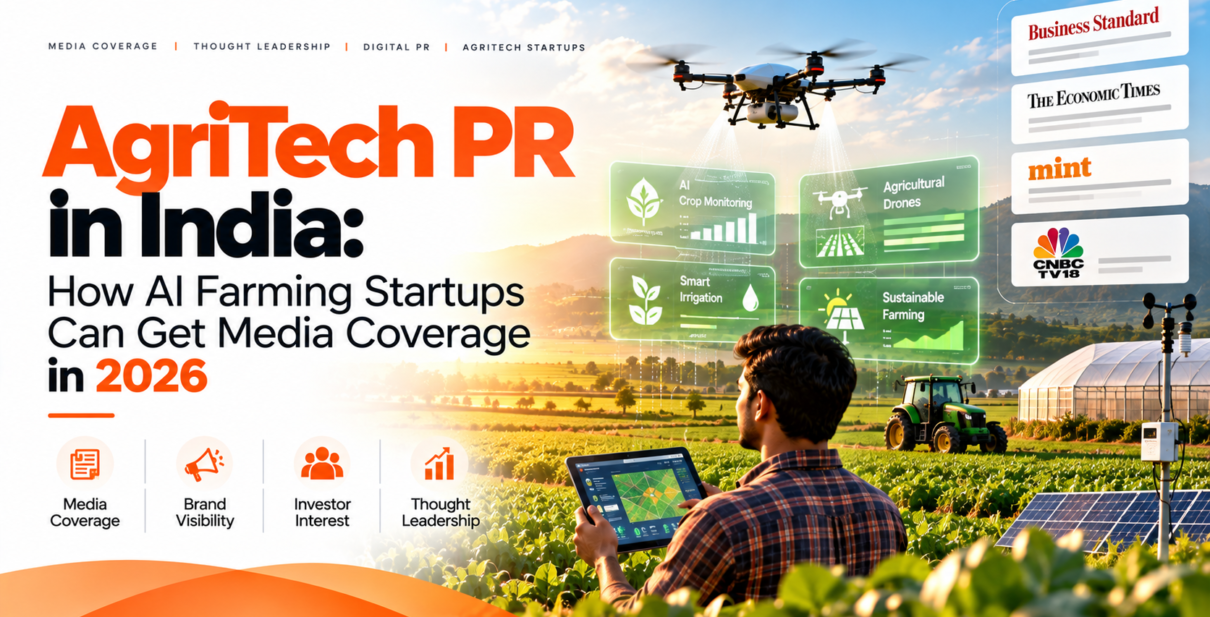
AgriTech PR Agency India
India’s agricultural technology ecosystem is bringing together artificial intelligence, precision agriculture, agricultural drones, smart irrigation, farm management platforms, and connected sensors. For startups developing these solutions, the challenge is no longer simply building technology. It is explaining why the innovation matters and earning the trust of the people expected to use it.
This is where an AgriTech PR agency in India can help. Strategic public relations translates complex agricultural technology into relevant stories that journalists, farmers, investors, distributors, and industry stakeholders can understand.
Why agritech PR agency India Need Specialized PR
AI farming businesses operate at the intersection of agriculture and technology. Their products may involve satellite imagery, crop monitoring, predictive analytics, automated irrigation, or precision spraying.
However, a technical feature does not automatically make a compelling media story.
Journalists and prospective customers need to understand the problem being solved, the people affected, and the evidence behind the solution.
A specialized PR strategy connects technical innovation with agricultural relevance. Instead of simply describing an AI platform, a startup can explain how it supports crop monitoring, helps users interpret field conditions, or addresses a specific operational challenge.
1. Turn Agricultural Innovation Into a Newsworthy Story
Successful AgriTech media coverage begins with a clear narrative.
AI farming startups can develop stories around product launches, new partnerships, field trials, funding announcements, technology deployments, research findings, and expansion into new agricultural markets.
The strongest story explains why the development matters beyond the company itself.
For example, a smart irrigation startup could present validated field trial findings, while an agricultural drone company might explain a new application for crop monitoring.
The central question is not simply what the product does, but why the development matters to agriculture.
2. Target the Right Agricultural and Technology Media
AgriTech startups should not limit their outreach to general business publications.
Potential media categories include agriculture and farming publications, technology media, startup platforms, financial newspapers, sustainability publications and regional business outlets.
Each category offers a different opportunity. Agricultural journalists may focus on farming applications, technology reporters may explore innovation, and business journalists may investigate commercial viability, investment, and market expansion.
Personalized outreach built around a journalist’s interests is generally more useful than sending the same announcement to every publication.
3. Use Founders as Industry Experts
Founders and technical leaders can become important sources of credible agricultural insight.
They can comment on AI adoption, precision farming, farm mechanization, water management, agricultural supply chains, and the practical challenges of introducing technology to farming communities.
Founder interviews, expert commentary, podcasts, contributed articles, and industry discussions can build visibility between major announcements.
For AI farming startups, this helps establish the founder as someone who understands both the technology and the agricultural problems it is designed to address.
4. Support Media Stories With Evidence
Agricultural audiences need practical information, not exaggerated promises.
Claims about crop productivity, irrigation savings, reduced input use, or operating efficiency should be supported by relevant evidence. Startups should explain the conditions under which results were achieved and avoid presenting limited trials as universal outcomes.
Useful supporting material can include field trial findings, expert interviews, documented deployments, original research, and clearly explained product demonstrations.
This evidence-based approach helps journalists assess the story and gives stakeholders a more reliable basis for evaluating the innovation.
5. Extend Media Coverage Through Digital PR
Traditional media coverage should form part of a wider digital PR strategy.
Online publications, expert articles, founder content, interviews, and credible third-party references can help maintain visibility after an announcement has been published.
These activities can also complement SEO by helping build a clearer digital presence around the company, its expertise, and its products.
For Advent PR, the opportunity is to connect AgriTech Media Relations with Digital PR, founder Thought Leadership, reputation management, and AI Search Optimization. No agency can guarantee search rankings or AI citations, but credible communication can support discoverability and brand understanding.
6. Measure Visibility Against Business Objectives
The success of AgriTech PR should not be measured solely by the number of articles published.
Relevant indicators include the quality of media coverage, message accuracy, share of voice, founder mentions, referral traffic, audience engagement, and inquiries from relevant stakeholders.
For a startup approaching investors, funding-related coverage and founder visibility may matter most. A company entering new agricultural markets may prioritise distributor relationships and regional coverage.
The metrics should reflect the business objective rather than a generic publicity target.
How Advent PR Can Support AgriTech Startups
Advent PR combines agriculture communications, media relations, digital PR, founder thought leadership, reputation management, SEO, and AI search optimization. Its existing agriculture PR offering addresses product announcements, agricultural innovation, funding visibility, and industry storytelling.
For AI farming startups, a focused communication strategy can help translate complex technology into stories that are relevant to the agricultural ecosystem.
Get an AgriTech Media Visibility Assessment from Advent PR. Identify your strongest story angles, relevant media categories, and opportunities to build credibility around your agricultural innovation.
Best Agriculture PR Agency In India | Build Stronger Visibility & Trust | Advent PR
Frequently Asked Questions
An AgriTech PR agency helps agricultural technology businesses build visibility through Media Relations, product launch communication, founder Thought Leadership, funding announcements, Digital PR and reputation management. The objective is to explain complex agricultural innovation to relevant audiences.
AI farming startups can generate media coverage through newsworthy product launches, validated field results, original research, partnerships, funding announcements, founder interviews and expert commentary on agricultural technology.
An AgriTech story becomes more compelling when it addresses a relevant agricultural problem, demonstrates a meaningful innovation, includes credible evidence and explains the implications for farmers, agribusinesses, investors or the wider industry.
AgriTech startups can target agricultural publications, technology media, startup platforms, financial and business newspapers, sustainability outlets and regional publications. The appropriate mix depends on the product, audience and communication objectives.
Yes. Companies can develop stories around field trials, technology launches, agricultural partnerships, research, product deployments, industry insights, founder expertise and documented operational results.
Digital PR can extend visibility through online media coverage, expert articles, interviews, founder content and credible third party references. It can complement SEO and help strengthen the information available about a startup, although it cannot guarantee rankings or AI recommendations.