



- November 18, 2026
- by adventpr
- Case Study, Industry insights
- 77 Views
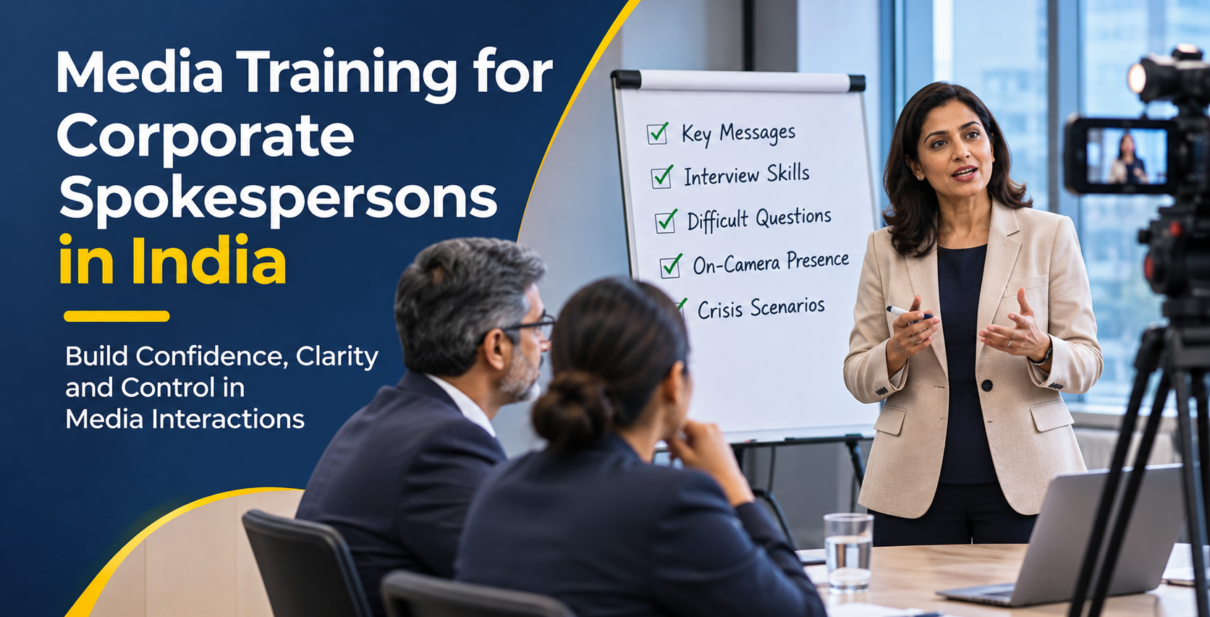
Media Training for Corporate Spokespersons in India
A media interview can influence how customers, investors, employees, and business partners perceive an organization.
For a CEO or company spokesperson, even a short conversation with a journalist requires preparation. The speaker must explain complex business matters clearly, respond to difficult questions, provide accurate information, and represent the organization consistently.
Many executives understand their industry well but have limited experience communicating with journalists. A technical explanation that works in a boardroom may not work in a television interview or a business news report.
This is why media training for corporate spokespersons has become an important part of public relations and corporate communication planning.
For Indian companies dealing with business media, television channels, digital publications and industry journalists, spokesperson preparation should be treated as an ongoing communication responsibility.
What Is Media Training for Corporate Spokespersons in India?
Media training prepares company representatives to communicate effectively with journalists and other media professionals.
It helps executives understand how interviews work, how to organize their messages, and how to respond when questions become difficult or unexpected.
A corporate media training programme may cover:
- Television and video interview preparation.
- Business newspaper and digital media interviews.
- Press conference preparation.
- Journalist Q&A simulations.
- Key message development.
- On-camera communication.
- Body language and voice control.
- Crisis interview preparation.
- Media statement development.
- Interview feedback and performance assessment.
The training should be based on the executive’s role, industry, communication objectives and likely media exposure.
A CEO preparing for a business television interview will have different requirements from a technical spokesperson discussing a product issue or a communications head responding to a corporate announcement.
Why Indian Companies Should Train Their Spokespersons
Companies often appoint senior executives as media representatives because they understand the business.
However, subject expertise alone does not guarantee effective media communication.
Here are six reasons businesses should invest in spokesperson preparation.
1. Explain Complex Business Information Clearly
Executives regularly deal with technical, financial and operational subjects.
A journalist may need a simple explanation of a company’s technology, business model, expansion plans or industry position.
A spokesperson should be able to explain these subjects without unnecessary jargon.
For example, a technology CEO discussing artificial intelligence should explain the business application, customer problem and limitations of the technology rather than relying entirely on technical terminology.
2. Prepare for Difficult Journalist Questions
Journalists may ask questions about declining performance, customer complaints, operational problems, industry competition or controversial business decisions.
Executives should practise answering such questions using verified information.
A good preparation process includes:
- Identifying likely difficult questions.
- Preparing accurate responses.
- Establishing what information is confidential.
- Identifying subjects requiring further verification.
- Practising how to acknowledge concerns.
- Knowing when to commit to a follow-up response.
The purpose is to communicate honestly and clearly, even when the subject is uncomfortable.
3. Maintain Consistent Corporate Messaging
Different company representatives may discuss the same business development with different audiences.
Without a common messaging framework, employees, executives and external spokespersons can communicate inconsistent information.
A message document should establish the organisation’s approved facts, key messages, supporting evidence and escalation contacts.
This is particularly useful during funding announcements, acquisitions, product launches, corporate restructuring and reputation-related situations.
4. Improve Television and Video Interview Readiness
Television and digital video interviews require additional preparation.
The spokesperson must consider camera positioning, eye contact, posture, voice, pace and the length of their responses.
Recorded mock interviews help executives identify habits that may not be obvious during normal conversations.
For example, an executive may speak too quickly, use unexplained abbreviations or give lengthy answers to simple questions.
Reviewing the recording allows the trainer and participant to work on specific improvements.
5. Prepare for Crisis Communication
During an operational or reputational issue, the spokesperson may face questions before all the facts are available.
A company should establish who can speak, which information has been verified and how updates will be approved.
Media simulations can help teams practise scenarios such as:
- Product complaints.
- Service disruptions.
- Data or technology incidents.
- Workplace incidents.
- Customer disputes.
- Regulatory investigations.
- Negative media coverage.
A spokesperson must not speculate or make commitments that the organisation cannot support.
6. Protect Long-Term Media Relationships
Journalists need accurate, relevant and timely information.
A spokesperson who understands the interview process can make it easier for journalists to understand the organisation’s position.
Preparation should include researching the publication, understanding the audience and reviewing the journalist’s relevant previous reporting.
The objective is a useful professional interaction, not an attempt to control independent editorial decisions.
7 Areas Every Corporate Media Training Programme Should Cover
1. Media Landscape and Journalist Expectations
Participants should understand the differences between print, television, digital publications, radio and podcasts.
Each format has different requirements.
A television interview may need short, clear answers, while a longer business publication interview may allow more detailed explanations.
2. Message Development
Prepare a message framework around the organisation’s communication objectives.
A useful framework includes:
- Three or four main messages.
- Supporting facts and examples.
- Relevant company information.
- Likely questions and answers.
- Topics requiring additional approval.
Messages should sound natural when spoken. Executives should understand the ideas rather than memorise a complete script.
3. Difficult Question Handling
Training should include questions about subjects that the spokesperson would prefer not to discuss.
For example:
Journalist: Your company recently received customer complaints about service quality. What is your response?
Unprepared response: We do not have any major problems. Our company has always delivered excellent services.
Better prepared response: We are aware of the concerns raised and are reviewing the specific cases. Our team is working to address the issues, and we will share verified updates with the affected customers.
The second response acknowledges the issue without making an unsupported claim.
4. On-Camera Communication
Participants should practise:
- Camera positioning.
- Eye contact.
- Body posture.
- Voice modulation.
- Answer length.
- Facial expressions.
- Interview opening and closing.
Recorded practice is particularly useful for identifying specific areas that need improvement.
5. Press Conference Preparation
Press conferences involve multiple journalists and may include questions from different subject areas.
Preparation should cover the event agenda, approved statements, spokesperson responsibilities, anticipated questions and follow-up procedures.
The company should also establish who is authorised to answer technical, financial and operational questions.
6. Crisis Interview Simulations
A crisis simulation should reproduce the pressure of a difficult media interaction.
The training team can introduce unexpected questions, new information and competing stakeholder concerns.
Participants should practise acknowledging what is known, identifying what remains unverified and explaining the next communication step.
7. Feedback and Performance Assessment
Training should finish with specific feedback.
The review can examine:
- Message clarity.
- Accuracy of statements.
- Confidence and delivery.
- Ability to handle difficult questions.
- Use of supporting evidence.
- Interview discipline.
- Consistency with corporate communication guidelines.
A follow-up session can check whether the participant has improved.
How to Choose a Media Training Agency in India
Selecting a media training provider requires more than comparing workshop duration and pricing.
Companies should consider the following factors.
Relevant PR and Media Relations Experience
Ask whether the provider understands business journalism, corporate communication and the Indian media environment.
Training should reflect the publications, formats and interview situations relevant to the organisation.
Industry-Specific Preparation
A financial services spokesperson may need to address regulatory developments and market-related questions.
A healthcare executive may need to communicate complex information accurately and sensitively.
A technology founder may need to explain technical developments to a non-technical audience.
The programme should reflect these differences.
Practical Interview Simulations
Ask whether the training includes recorded interviews, mock press conferences, difficult-question exercises and individual feedback.
A presentation-only workshop may not provide enough practice for an executive who regularly faces journalists.
Crisis Communication Experience
If senior executives may need to respond to operational or reputational issues, ask whether the training covers crisis scenarios, approval protocols and stakeholder communication.
Post-Training Support
Understand whether the provider offers refresher sessions, interview preparation and support for future media interactions.
Clear Scope and Reporting
Before signing an agreement, clarify:
- Number of participants.
- Training duration.
- In-person or virtual format.
- Customisation requirements.
- Training materials.
- Recording and feedback arrangements.
- Post-training support.
- Commercial terms.
The agency should explain exactly what is included.
What Does Media Training Cost in India?
Media training costs vary according to the trainer’s experience, number of participants, session duration, level of customisation and production requirements.
A short individual coaching session is different from a multi-day programme for a senior leadership team.
When evaluating proposals, ask for a breakdown of:
- Pre-training assessment.
- Message development.
- Interview simulations.
- Video recording and playback.
- Individual feedback.
- Crisis scenario exercises.
- Follow-up sessions.
Request a written scope before comparing prices. Do not assume that every programme described as media training includes all these components.
When Should a Company Arrange Media Training?
Media training should be considered before an important communication event.
Examples include:
- A funding announcement.
- A merger or acquisition.
- A major product launch.
- A new market entry.
- A business television interview.
- An annual results announcement.
- A regulatory or policy discussion.
- A corporate reputation issue.
- A leadership transition.
- A major industry conference.
Companies with regular media exposure should also consider periodic refresher sessions.
Training conducted well before an announcement gives executives time to prepare and practise.
How AdventPR Can Support Corporate Media Communication
AdventPR works across public relations, media relations, crisis communication, reputation management and corporate communications.
These areas are relevant when a company needs to prepare its senior leadership for public communication.
A corporate media preparation requirement should begin with an assessment of the organisation’s objectives, spokesperson responsibilities, likely media exposure and communication risks.
AdventPR can discuss the appropriate PR and media relations support for:
- Business media engagement.
- Corporate announcements.
- Executive communication.
- Media response planning.
- Crisis communication coordination.
- Reputation management.
- Leadership positioning.
For companies seeking a dedicated recorded media training workshop, confirm the programme format, trainers and deliverables with AdventPR before engagement.
Looking for Media Relations Support for Your Business?
Is your CEO preparing for a business interview? Does your company have an upcoming press conference or corporate announcement? Are your spokespersons ready to handle difficult journalist questions?
Discuss your requirements with AdventPR.
The team can review your media communication needs and identify suitable PR, media relations and corporate communication support.
Advent Public Relations
Website: https://adventpr.com/
Email: info@adventpr.com
Phone: +91 93199 71631
Explore AdventPR’s PR services in Delhi NCR or contact the team to discuss your requirements.
Frequently Asked Questions
Media training prepares company representatives to communicate accurately and confidently with journalists across print, television, digital media, podcasts and press conferences.
CEOs, founders, senior management, corporate communications heads, designated spokespersons and technical experts who represent the company publicly can benefit from media training.
Duration depends on the number of participants and the programme’s scope. Individual coaching, a half-day workshop and a multi-session leadership programme have different requirements.
A programme may include message development, journalist Q&A, mock interviews, on-camera practice, body language feedback, crisis simulations and post-session assessment.
Yes. Founders who participate in funding announcements, investor interviews, product launches and business media discussions can benefit from interview preparation and message development.