



- November 16, 2026
- by adventpr
- Branding, Case Study
- 69 Views
Microdrama Marketing in India
A family gathering, an unexpected business decision, a relationship conflict, or a surprising announcement. Imagine turning one of these everyday situations into a series of short videos that audiences look forward to watching.
This is the idea behind microdrama marketing.
Indian brands are increasingly exploring short, episodic storytelling to communicate their products and services through entertainment. Instead of relying entirely on conventional advertisements, businesses are experimenting with characters, connected storylines, and episodes that give viewers a reason to return.
The format is receiving attention across India’s advertising and content industries in November 2026.
HDFC Life recently introduced a four-episode digital microdrama called Lift Your Protection, using an everyday elevator setting to make conversations about life insurance more relatable to younger audiences. Hyundai Motor India has also used a six-episode Diwali-themed story to connect its vehicles with family experiences and memories.
These campaigns point towards a communication opportunity for brands: create stories that people choose to watch, rather than simply placing another advertisement in their social media feed.
For founders, CMOs and marketing teams, the question is how to use this format without making the entertainment feel like a sales pitch.
What Is Microdrama Marketing in India?
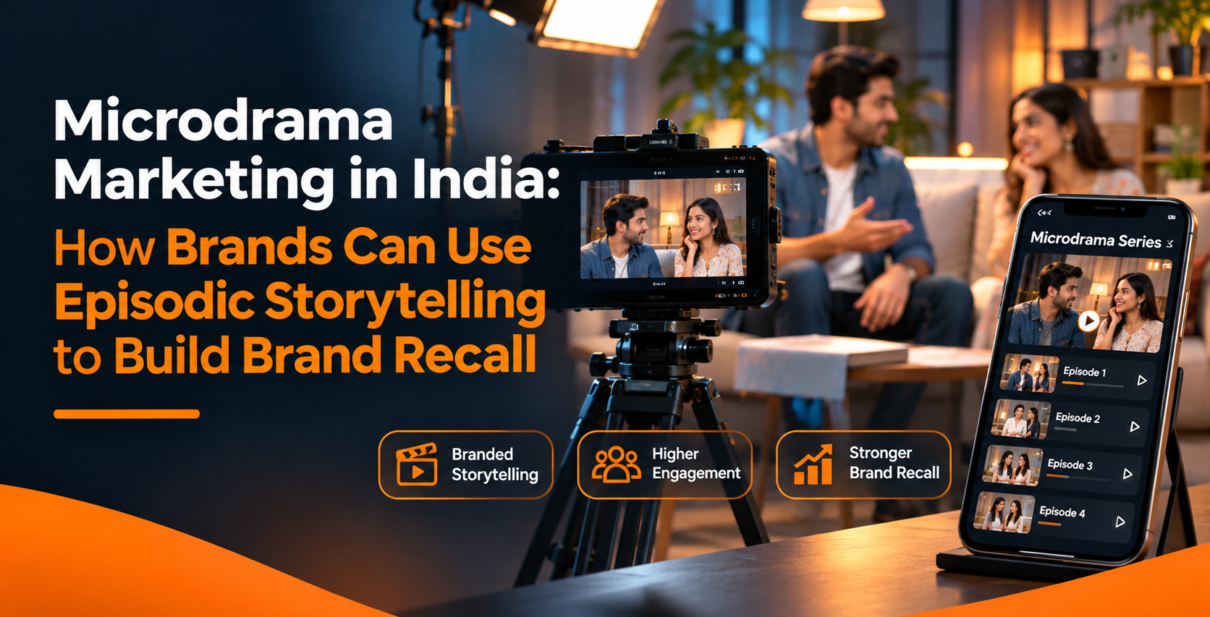
Microdrama marketing is a brand communication approach that uses short, connected video episodes to tell a story around a brand, product, service or audience insight.
Unlike a standalone advertisement, a microdrama follows a narrative across multiple episodes. Each episode may introduce a situation, develop a character, reveal a problem or create curiosity about what happens next.
Episodes commonly run for one to four minutes, although the duration can vary by platform and content strategy.
A typical branded microdrama may include:
- A recurring set of characters.
- A relatable situation or central conflict.
- Short episodes with a clear narrative progression.
- Natural integration of a brand or product.
- A reason for viewers to continue watching.
- A consistent theme connected to the brand’s positioning.
For example, an insurance company could create a story about young professionals making important decisions about family responsibilities. A home improvement brand could build a series around a family renovating its first home.
The product remains part of the story, but the story gives the audience a reason to watch.
Why Microdrama Is Getting Attention in India’s Marketing Industry
The growth of microdrama is connected to changing mobile video consumption habits.
A Meta and Ormax Media report, released in March 2026, studied microdrama audiences across 14 Indian states.
Its findings included:
- 89% of surveyed viewers discovered microdramas through social feeds.
- Viewers spent a median of 3.5 hours per week watching microdramas.
- Approximately 90% watched microdramas alone.
- 65% said they had discovered the format within the previous year.
The research combined 50 in-depth interviews with 2,000 personal interviews among audiences aged 18–44, conducted between November 2025 and January 2026.
These findings indicate that social distribution and repeat viewing are important characteristics of the format.
Redseer’s November 12, 2026 analysis also describes the scale of India’s developing microdrama audience. Its October advertising analysis estimated that microdrama advertising revenue was approximately ₹24 crore in FY2026 and projected growth to ₹5,000–5,500 crore by FY2032. This is a market forecast, not an achieved revenue figure.
For marketers, the opportunity is worth watching. As distribution and advertising models develop, microdrama may become another option within a brand’s wider video and communications strategy.
How Indian Brands Are Experimenting With Microdrama
Recent campaigns offer useful examples of how companies are approaching episodic storytelling.
1. HDFC Life: Making Financial Protection Part of Everyday Stories
HDFC Life launched Lift Your Protection, a four-episode digital microdrama in November 2026.
The series uses an elevator setting and everyday situations involving different individuals to introduce conversations about financial protection and life insurance.
Instead of making every episode a direct explanation of an insurance product, the campaign uses a familiar environment to connect the subject with everyday responsibilities.
This is relevant for brands operating in categories where consumers may understand the importance of a product but postpone acting on it.
2. Hyundai: Connecting a Product With Family Memories
Hyundai Motor India’s six-episode Diwali series, Diwali Chori Ho Gayi!, was developed with Terribly Tiny Tales.
The story follows a family’s celebrations and memories, with Hyundai vehicles appearing naturally within the narrative.
The communication approach gives the brand a role in the characters’ lives rather than structuring every episode around product features.
3. Godrej: Bringing Multiple Products Into One Story
Godrej Enterprises Group’s Second Gen Kumars used an eight-episode Instagram series centred on a contemporary family setting.
The format allowed different products from the group’s consumer businesses to appear within a shared narrative.
This shows how branded entertainment can provide a common storytelling environment for multiple products or business categories.
These examples demonstrate different ways of approaching the format. They do not establish that every microdrama campaign will generate the same business results.
Microdrama vs Reels vs Traditional Advertising
Brands should understand the difference before investing in production.
| Format | Main purpose | Typical structure |
|---|---|---|
| Traditional advertisement | Communicate an offer, product or brand message | A single promotional film |
| Social media Reel | Capture attention and communicate a short idea | Usually a standalone video |
| Microdrama | Develop a narrative that encourages repeat viewing | Multiple connected episodes |
| Branded entertainment | Build an entertainment property around brand themes or values | A larger content series or recurring property |
A Reel can introduce a character or situation, but it does not automatically become a microdrama.
The defining feature is narrative continuity. Characters, situations and events develop across episodes, giving audiences a reason to continue.
The objective is also different. A conventional advertisement may try to communicate several product benefits within a short period. A microdrama needs to make the audience interested in what happens next.
6 Ways Brands Can Use Microdrama Marketing
Microdrama is not limited to one industry. The format can work across categories where brands have relatable customer situations or useful stories to tell.
1. Consumer and FMCG Brands
Food, personal care, fashion and household brands can build stories around everyday routines, family interactions, friendships and buying decisions.
For example, a food brand could develop a short series around the preparations, disagreements and humour of a family gathering.
The product should appear naturally within the characters’ lives rather than interrupt the story with repeated promotional messages.
2. Financial Services and Insurance
Financial products can sometimes feel difficult to understand or emotionally distant.
Banks, insurers and financial service businesses can use everyday situations to explain subjects such as financial preparedness, responsible borrowing, family protection and savings habits.
Any product claims, financial information and disclosures must remain accurate and comply with applicable regulations.
3. Real Estate and Home Improvement
Real estate brands can explore stories about first-time homebuyers, family decisions, moving into a new home or renovating a living space.
A narrative can communicate features such as convenience, location, design and lifestyle without relying only on a list of specifications.
4. Education and EdTech
Education brands can develop stories around students, career choices, examinations, skill development and workplace transitions.
These subjects can connect with students and parents through relatable characters and situations.
Claims about placements, qualifications and learning outcomes must be substantiated.
5. Healthcare and Wellness
Healthcare and wellness companies can use storytelling to build awareness about preventive health, everyday habits and the importance of seeking qualified professional guidance.
The creative approach should prioritise factual information, responsible communication and appropriate expert review.
6. Technology and SaaS Companies
Technology brands can develop workplace stories showing how teams manage operational problems, improve processes or adopt new tools.
A SaaS company, for instance, could build episodes around the challenges faced by a growing business and how better workflows help its employees.
The story should explain the problem before presenting the product as part of the solution.
How to Create a Branded Microdrama That People Actually Want to Watch
The biggest mistake a brand can make is taking a conventional advertisement, dividing it into five videos and calling the result a microdrama.
An effective series needs a story that can stand on its own.
Here is a practical framework.
Step 1: Start With an Audience Insight
Identify a situation that your intended audience understands.
Ask:
- What problems do customers regularly face?
- Which everyday situations connect with the brand?
- What emotions or decisions are relevant to the audience?
- What subjects would make someone interested in watching another episode?
The story should begin with a human observation, not a product feature list.
Step 2: Define the Brand’s Role
Decide how the brand fits into the narrative.
There are several possible approaches:
Ambient integration: The product appears naturally in the characters’ surroundings.
Narrative integration: The product or service plays a relevant role in the story’s development.
Recurring integration: The product appears naturally across multiple episodes.
Branded content property: A larger series is created around the brand’s values, audience or business category.
The right approach depends on the campaign objective and the strength of the connection between the story and the brand.
Step 3: Build Characters and a Clear Storyline
Create characters with recognisable motivations and believable relationships.
A series needs a central situation that develops over time. The audience should understand why the characters are making decisions and what is at stake.
A basic storyline may include an introduction, a conflict, an unexpected development and a resolution.
Step 4: Structure Each Episode
Every episode should have a purpose.
A possible five-episode structure:
- Episode 1 – The Hook: Introduce the characters and an interesting situation.
- Episode 2 – The Conflict: Reveal the problem that changes the situation.
- Episode 3 – The Complication: Introduce another decision or unexpected development.
- Episode 4 – The Turning Point: Show how the characters respond.
- Episode 5 – The Resolution: Deliver a satisfying conclusion and connect it with the brand’s message.
This is an illustrative structure, not a fixed formula. The number and duration of episodes should follow the story and distribution plan.
Step 5: Choose the Right Distribution Channels
Microdramas are often designed for smartphone viewing and social discovery.
Brands can consider Instagram, YouTube, Facebook and relevant short-video ecosystems, depending on their target audience and available distribution options.
The production should account for mobile-first viewing, captions, readable visuals, suitable episode length and consistent presentation.
The distribution strategy should also define how viewers will discover later episodes after watching the first one.
Step 6: Keep the Brand Message Consistent
The brand should have a clear reason to be part of the story.
Its role should connect with the overall communication objective without dominating every scene.
A viewer should understand the brand’s relevance while remaining interested in the characters and narrative.
The Role of Public Relations in Microdrama Marketing
Microdrama is a content format, but its value can extend beyond the videos themselves.
This is where public relations and strategic communications can support the campaign.
1. Develop the Brand Story
PR teams can help identify the message the brand wants to communicate and connect it with a relevant audience insight.
The communication strategy should explain why the story belongs to the brand and what the audience should understand after watching it.
2. Connect Branded Content With Earned Media
A strong branded series may create a wider communications opportunity.
Depending on the concept and execution, the campaign could be pitched to relevant marketing, business, entertainment and industry publications.
Media coverage may focus on the creative idea, the campaign objective, audience relevance, production collaboration or the brand’s content strategy.
Coverage should be earned through relevant editorial interest rather than assumed as a result of publishing the series.
3. Create Leadership and Industry Commentary
Senior marketers and brand leaders can contribute to industry discussions about entertainment-led marketing, digital storytelling and changing video consumption.
Expert articles, interviews and conference discussions can help explain the organisation’s approach and its lessons from the campaign.
4. Maintain Brand Reputation
The story, product claims, partnerships, talent and distribution should be reviewed before publication.
PR and marketing teams should work with legal and compliance teams where necessary, especially for campaigns involving financial services, healthcare or other regulated categories.
5. Extend the Campaign Into Other Communication Channels
A microdrama can provide source material for other formats:
- Behind-the-scenes interviews.
- Director and creative-team conversations.
- Short character introductions.
- Campaign announcement stories.
- Leadership commentary.
- Media engagement.
- Campaign recap and results content.
This allows the brand to build a connected communication programme around one creative property.
How to Measure Microdrama Marketing Performance
High view counts do not necessarily mean the audience has understood or remembered the brand.
A useful measurement framework should examine both entertainment performance and brand outcomes.
| KPI | What it tells the brand |
|---|---|
| Initial video retention | Whether the opening attracts attention |
| Episode completion rate | Whether viewers finish an episode |
| Episode-to-episode progression | Whether viewers continue the story |
| Average viewing duration | How much of the content audiences watch |
| Shares and conversations | Whether viewers respond to the narrative |
| Brand recall | Whether viewers remember the brand |
| Message association | Whether viewers connect the brand with the intended message |
| Branded search activity | Whether interest in the brand changes during the campaign |
| Referral traffic | Whether viewers visit the company’s digital properties |
| Qualified enquiries and conversions | Whether the campaign contributes to business outcomes |
It is useful to measure brand recall through audience surveys or an independent brand-lift study where the campaign budget permits.
Production analytics can reveal which episodes retain viewers. They cannot, on their own, prove that the brand message was remembered or influenced a purchase.
The measurement plan should be finalised before the campaign begins.
Common Mistakes Brands Should Avoid
Turning every episode into a sales pitch: Viewers may disengage when the story feels like an advertisement.
Starting with product features: Begin with an audience insight and a relatable situation.
Ignoring episode continuity: Each video should contribute to the wider storyline.
Choosing a format only because it is trending: A brand should assess whether episodic storytelling suits its audience, product and communication objectives.
Depending only on views: Measure completion, story progression, brand recall and commercial outcomes.
Overlooking production and distribution costs: A connected series requires planning for scripting, talent, editing, localisation, distribution and measurement.
Ignoring language and regional context: Stories should reflect the audience’s cultural setting, language preferences and viewing habits.
A 60-Day Microdrama Marketing Plan for Brands
Businesses that want to test the format can begin with a focused pilot rather than committing immediately to a large entertainment property.
Days 1–15: Research and Strategy
- Define the campaign objective.
- Identify the primary audience.
- Study relevant audience interests and viewing behaviour.
- Develop the central story concept.
- Establish the brand’s role in the narrative.
- Decide how success will be measured.
Expected output: Audience brief, creative concept, brand message and distribution plan.
Days 16–30: Development and Production Planning
- Develop characters and episode outlines.
- Write the scripts.
- Review product claims and brand integration.
- Select talent and production partners.
- Plan formats, captions and language versions.
- Finalise approvals and publishing schedules.
Expected output: Approved scripts, production plan and campaign assets.
Days 31–45: Launch and Distribution
- Release the opening episode.
- Monitor initial audience retention.
- Publish subsequent episodes.
- Use platform-native promotions where appropriate.
- Track comments, shares and episode progression.
- Respond to relevant audience questions.
Expected output: A live episodic campaign with performance data.
Days 46–60: Measurement and Evaluation
- Review episode completion and viewer drop-off.
- Evaluate brand recall and message association.
- Review audience feedback.
- Analyse relevant website traffic and enquiries.
- Compare performance against the original objectives.
- Identify improvements for a second series.
Expected output: Campaign report and recommendations for future content.
Conclusion: Brands Need Stories Worth Watching
Microdrama marketing is creating another option for Indian brands looking to communicate through digital entertainment.
The format combines short-form video with connected storytelling. Its appeal lies in giving audiences a reason to return to a story rather than treating every video as an isolated advertisement.
Recent campaigns from brands such as HDFC Life, Hyundai and Godrej show how different businesses are experimenting with this approach.
However, the format will not work simply because it is popular. The story needs to connect with the audience, the brand needs a natural role, and the campaign needs a measurement plan that goes beyond views.
For founders and marketing leaders, microdrama should be considered as part of a wider brand storytelling and communications strategy.
How AdventPR Can Help
AdventPR helps businesses develop strategic PR, Digital PR, brand communication and content-led visibility strategies.
From brand positioning and storytelling to media relations and campaign communication, the objective is to make every brand message relevant to the audience and consistent with the organisation’s identity.
Planning a storytelling-led campaign for your brand?
Connect with AdventPR to discuss a strategic brand communication and Digital PR programme.
Frequently Asked Questions
Microdrama marketing uses short, connected video episodes to communicate a brand message through entertainment. Indian brands are experimenting with the format across categories such as insurance, automotive, fashion and consumer products.
A Reel can be a standalone video. A microdrama is a connected narrative in which characters and situations develop across multiple episodes. The audience has a reason to return to the next part of the story.
Brands are exploring microdrama because episodic storytelling provides an opportunity to integrate products and brand messages into content audiences choose to watch. It may support familiarity, message recall and engagement, depending on the story and execution.
Consumer goods, financial services, insurance, fashion, automotive, real estate, education, healthcare and technology businesses can explore microdrama where their products or services connect naturally with relatable audience situations.
Episodes commonly run for one to four minutes, although the ideal duration depends on the platform, story complexity and audience behaviour. Brands should test formats rather than assume one duration will work for every campaign.
Businesses can measure initial retention, completion rates, episode progression, viewing duration, shares, brand recall, message association, referral traffic and qualified enquiries. The measurement framework should reflect the campaign’s main objective.
Small businesses can test short episodic stories with a limited number of episodes and focused production budgets. They should validate the story concept and target audience before investing in a larger series.
A PR agency can support brand positioning, storytelling strategy, campaign communication, media engagement, leadership visibility and reputation considerations. Production and distribution can be coordinated with specialist creative and platform partners.