


- September 14, 2026
- by adventpr
- Uncategorized
- 27 Views
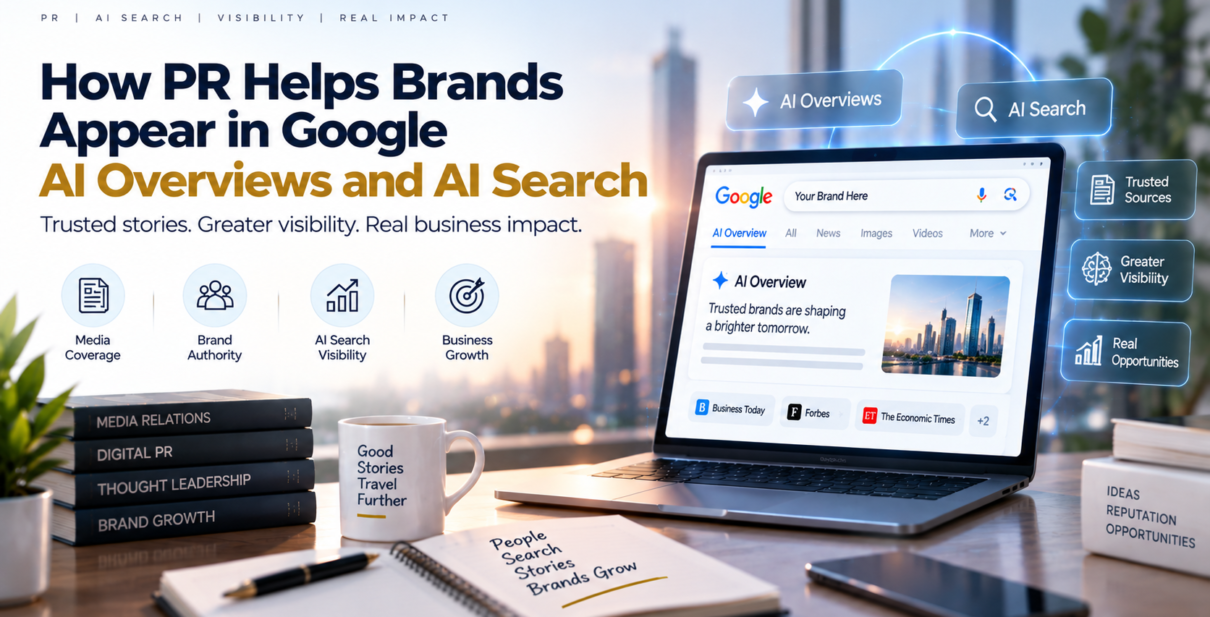
Google Search is changing how people discover brands, businesses, and information. Users can now receive AI-generated responses in Search through experiences such as AI Overviews and AI Mode, with links that allow them to explore supporting websites and sources. Google says its AI search experiences continue to surface relevant web content and links, while its guidance remains clear that traditional SEO fundamentals still matter.
For brands, this creates a new visibility question:
When a potential customer asks an AI-powered search engine about your category, company or competitors, does your brand appear in the information it surfaces?
This is where PR for AI search visibility becomes increasingly relevant.
PR does not provide a shortcut into Google AI Overviews. It can, however, help build the authoritative, discoverable and consistent information ecosystem around a brand that supports visibility across modern search.
What Is AI Search Visibility?
AI search visibility refers to how often and how accurately a brand, company, executive or service appears within AI-generated search experiences.
A person may ask:
“What are the leading FinTech companies in India?”
Or:
“Which PR agencies specialise in healthcare?”
Or:
“How can a startup build media visibility in India?”
Instead of returning only a traditional list of links, AI-powered search experiences may synthesise information and provide supporting sources.
Google explains that AI Overviews and AI Mode use relevant links to help users explore information across the web.
For businesses, this means visibility increasingly depends on more than ranking one webpage for one keyword.
It also depends on whether reliable information about the brand exists across the wider web.
Why PR Matters in AI Search
A company website is one source of information about a brand.
It is not the only one.
AI-powered search experiences can encounter information through websites, editorial coverage, interviews, industry publications and other publicly accessible sources.
That gives PR a new role.
Traditional PR asks:
“Can we get the brand covered by the media?”
AI-focused PR adds another question:
“Does this coverage strengthen the information and authority that search systems can discover about the brand?”
Advent PR describes this broader shift as moving from simple media visibility toward discoverability, authority and AI citations. Its current AI visibility framework combines media relations, Digital PR, SEO, GEO, AEO and Executive Thought Leadership.
How Digital PR Can Support AI Search Visibility
1. Build third-party authority
A brand talking about itself is expected.
Independent organizations, journalists, industry publications, and credible business websites discussing the brand provide additional context.
Digital PR can help create that broader footprint through:
- Editorial coverage
- Expert interviews
- Founder commentary
- Bylined articles
- Original research
- Industry reports
- Case studies
- Relevant business publications
The objective is not to manufacture mentions.
Google’s current guidance specifically warns against seeking inauthentic mentions and other attempts to manipulate generative AI search visibility.
The better approach is to earn relevant coverage because the company has something useful, credible, or newsworthy to contribute.
2. Make the brand easier to understand
AI systems need clear information to understand entities and relationships.
A company should keep information consistent across its website and credible external sources.
That includes:
Company name → category → services → expertise → leadership → locations → products → industries → evidence
For example, a healthcare PR agency should not describe itself one way on its website, another way in interviews, and a third way across business profiles.
Consistent positioning makes the company’s identity easier for audiences and search systems to interpret.
3. Build executive authority
One of the strongest ways PR can support AI visibility is through expert positioning.
Suppose a cybersecurity company’s CEO regularly contributes commentary on ransomware, data protection and enterprise security.
The company is then associated with a defined subject area.
Similarly, a FinTech founder can build authority around digital lending, payments or financial inclusion.
A healthcare executive can comment on healthcare communication, HealthTech or patient trust.
This produces a wider expertise footprint around the brand.
PR + SEO: The Foundation Still Matters
AI Search should not be treated as a replacement for SEO.
Google’s official guidance states that existing SEO best practices remain relevant for AI Overviews and AI Mode. Websites still need to be crawlable, indexable, and useful, with important content available in textual form and a strong page experience. Google also says there are no additional technical requirements or special schema needed specifically for AI features.
That means a strong AI search optimization strategy should connect:
Technical SEO → Helpful content → Internal linking → Digital PR → Expert authority → Third-party coverage → Brand consistency
PR strengthens the authority layer.
SEO strengthens the discoverability layer.
Together they create a stronger organic visibility system.
Which Brands Should Invest in PR for AI Search?
AI search visibility can be particularly valuable for businesses where customers research before making a decision.
This includes:
B2B Technology Companies
SaaS, AI, cybersecurity, cloud and enterprise technology companies can use PR to establish expertise around complex categories.
Financial Services Brands
Banks, NBFCs, FinTech companies, wealth-management firms and investment businesses operate in trust-sensitive categories where authority matters.
Healthcare Brands
Hospitals, HealthTech, pharma and medical technology companies can use evidence-led PR and expert communication to build credible information around their areas of expertise.
Startups
Startups can use founder PR, funding announcements, product stories, research and industry commentary to establish recognition beyond their own websites.
Professional Services Firms
Consulting, legal, recruitment, marketing and other expert-led businesses can build visibility around specialist knowledge.
What Does a GEO + PR Strategy Look Like?
Generative Engine Optimization (GEO) should not become a collection of tricks designed to manipulate an AI system.
Google’s current documentation specifically says there is no requirement for special AI files, “LLM” markup or a special schema to appear in generative AI search. It also says there is no ideal page length or requirement to artificially split content into tiny sections.
A better GEO strategy is about strengthening the underlying content and authority of the business.
A practical process is:
1. Define the topics you want to own.
2. Create useful first-party content around those topics.
3. Develop executives as credible subject-matter experts.
4. Earn relevant third-party media coverage.
5. Build consistent information across the company’s digital ecosystem.
6. Strengthen internal linking and technical SEO.
7. Monitor how the brand appears across AI-powered search experiences.
This makes AI visibility part of a broader organic growth strategy.
Can PR Guarantee Google AI Overview Visibility?
No.
This is an important distinction.
A PR agency can improve the conditions that support discoverability and authority, but it cannot guarantee that Google AI Overviews will cite or recommend a specific brand.
Google states that AI Overviews and AI Mode select links based on relevance and that simply meeting technical requirements does not guarantee crawling, indexing or serving.
AI systems also change their responses depending on the query, context, sources and underlying retrieval systems.
Therefore, the correct commercial promise is:
Build the authority and information ecosystem that gives the brand a stronger opportunity to be discovered and cited.
Not:
“Pay us and Google AI will feature your company.”
What Should Brands Measure?
AI visibility needs a broader measurement framework than traditional media coverage.
Track:
AI mentions—Is the brand being identified?
AI citations—Is the brand’s website or external coverage being used as a source?
Recommendation visibility—Does the brand appear when users ask for providers or options?
Brand accuracy—Is the AI describing the company correctly?
Share of AI visibility—How often does the brand appear relative to competitors?
Media authority—Which credible publications are discussing the brand?
Branded search—Are more people searching specifically for the brand?
Organic conversions—Are AI- and search-driven visitors generating enquiries?
Google has also introduced dedicated Search Console reporting for visibility from generative AI features in Search, with views including impressions, pages, countries, devices and dates.
That creates a more practical measurement opportunity for SEO and AI visibility teams.
How Advent PR Approaches AI Search Visibility
Advent PR treats AI visibility as an extension of SEO, Digital PR and brand authority, rather than as a separate technical hack.
Its current AI visibility approach brings together:
Media Relations
Digital PR
SEO
AI Search Optimization
GEO
AEO
Executive Thought Leadership
Reputation Management
The objective is to build a credible information ecosystem around the brand so that it is easier for people—and AI-powered discovery systems—to understand what the company does, what it is known for and why it is relevant.
That means the work starts with authority, not artificial mentions.
Final Thoughts
AI Search is changing how people discover information, but the fundamentals of organic visibility remain familiar.
Brands still need useful content.
They still need technical SEO.
They still need expertise.
They still need credible third-party references.
And they still need a clear, consistent identity.
What is changing is the environment in which that authority is discovered.
For modern brands, PR for AI search visibility means thinking beyond individual media placements and building a wider system of authority:
Get published → Build credibility → Strengthen discoverability → Earn citations → Increase brand visibility
The brands most likely to benefit are not those searching for an AI-search shortcut.
They are the ones investing in useful content, credible expertise, strong SEO, and genuine digital PR.
Build Your AI Search Visibility Strategy
Is your brand visible in Google AI Overviews, AI Mode, and other AI-powered search experiences?
Advent PR combines digital PR, media relations, SEO, GEO, AEO, and executive thought leadership to help businesses build stronger organic authority and improve their visibility across traditional and AI-powered discovery.
Talk to Advent PR about building an AI search visibility and digital PR strategy for your brand.
Frequently Asked Questions
PR can support AI search visibility by building credible media coverage, expert content and third-party references around a brand. However, no PR agency can guarantee that a brand will appear in a specific Google AI Overview.
PR for AI search visibility combines media relations, Digital PR, thought leadership and authoritative content to strengthen a brand’s online presence and make its expertise easier to discover across AI-powered search experiences.
Digital PR can create credible third-party coverage, expert commentary, interviews and editorial references that strengthen a brand’s authority and provide additional sources of information about the company across the web.
SEO focuses on visibility in traditional search results, while GEO (Generative Engine Optimization) focuses on visibility across generative AI experiences. AEO (Answer Engine Optimization) focuses on making content more useful and discoverable for answer-based search experiences.
A PR agency can help improve the conditions that may lead to AI citations by building authoritative content, credible media coverage and a consistent information ecosystem. Citation placement itself cannot be guaranteed because AI search systems determine which sources they use.
Businesses can monitor brand mentions, citations, recommendation frequency, branded searches, referral traffic, organic enquiries and visibility across relevant AI search queries. These metrics can be combined with traditional SEO and PR performance data to evaluate overall brand authority.