


- July 8, 2026
- by adventpr
- Case Study
- 499 Views
If You Read Only Five Marketing Websites in 2026, Read These
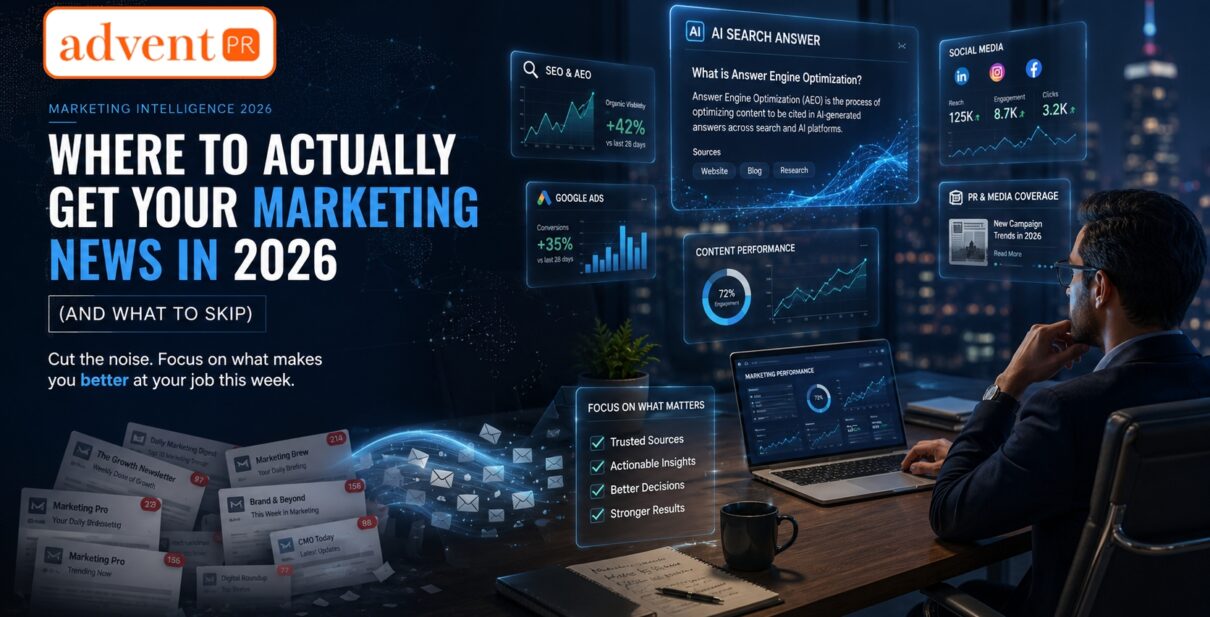
Marketing has changed dramatically over the last few years. Search engines are becoming answer engines, artificial intelligence is transforming how people discover brands, and digital platforms are evolving faster than ever. For marketers, agency leaders, founders, and business owners, the challenge is no longer finding information—it’s finding information that is accurate, actionable, and worth your time.
Every day, hundreds of articles, newsletters, LinkedIn posts, podcasts, and YouTube videos promise to reveal the latest marketing trends. Unfortunately, much of this content repeats the same ideas without adding new insights.
The smartest marketers in 2026 don’t consume more content. They consume better content.
This guide identifies the most reliable marketing news sources, explains when to use each one, and provides a practical reading framework to help you stay informed without becoming overwhelmed.
What Makes a Marketing News Source Trustworthy?
Before subscribing to another newsletter or bookmarking another blog, evaluate whether the source meets these criteria:
- Publishes fact-based, research-backed content
- Updates information regularly
- Clearly identifies authors and contributors
- Cites original data and official announcements
- Offers practical implementation guidance instead of clickbait
- Maintains editorial consistency
- Covers emerging technologies such as AI Search, Generative Engine Optimization (GEO), Answer Engine Optimization (AEO), Semantic SEO, and Digital PR
Reliable information creates better marketing decisions.
The Best Marketing News Sources in 2026
1. Search Engine Journal
Best For: SEO professionals, content marketers, agencies, technical SEO, AI Search
Search Engine Journal remains one of the industry’s most respected publications for search marketing. It covers Google algorithm updates, SEO strategies, AI search developments, content marketing, PPC, analytics, and emerging digital marketing trends.
Why it matters:
- Daily industry updates
- Expert contributors
- Technical SEO guidance
- Google AI Overviews coverage
- Practical implementation advice
Ideal for:
- SEO specialists
- Marketing agencies
- Content strategists
- Website owners
2. Search Engine Land
Best For: Google Search, PPC, SEO, AI Search Optimization
Search Engine Land provides timely reporting on search engine updates, paid advertising, search technology, and AI-driven search experiences.
Its strength lies in translating complex platform changes into practical recommendations that marketers can immediately implement.
Key topics include:
- Google Search
- Google Ads
- AI-powered search
- Local SEO
- Retail media
- Technical SEO
3. Think with Google
Best For: Consumer insights, advertising research, market trends
When marketers need credible statistics, consumer behavior research, or advertising insights, Think with Google is one of the most authoritative sources available.
Because it publishes first-party research, it offers valuable information about:
- Consumer behavior
- Digital advertising
- AI adoption
- Search trends
- Video marketing
- Retail insights
- Measurement frameworks
Its reports are frequently referenced in client presentations and strategic planning.
4. BestMediaInfo
Best For: Indian marketing, advertising, media, PR
Global publications often overlook India’s unique business landscape.
BestMediaInfo provides localized coverage of:
- Advertising
- Public relations
- Brand campaigns
- Agency partnerships
- Marketing leadership
- Industry regulations
- Business announcements
For marketers working with Indian brands, these insights are often more relevant than international case studies.
5. Marketing Dive
Best For: Marketing strategy, brand campaigns, advertising innovation
Marketing Dive focuses on:
- Brand strategy
- Consumer trends
- Marketing technology
- Digital advertising
- Industry analysis
Rather than reporting every platform update, it explains what changes mean for businesses and marketers.
6. HubSpot Blog
Best For: Content marketing, inbound marketing, CRM, automation
HubSpot continues to publish high-quality educational content covering:
- Content strategy
- Email marketing
- Lead generation
- Sales alignment
- Customer experience
- Marketing automation
Its beginner-to-intermediate resources remain among the most comprehensive available.
7. Ahrefs Blog
Best For: SEO, content marketing, keyword research
Ahrefs publishes practical guides supported by original research.
Topics include:
- Keyword research
- Link building
- Content optimization
- Technical SEO
- Search intent
- AI-assisted content workflows
The emphasis is on actionable advice rather than theory.
8. Semrush Blog
Best For: Competitive intelligence, SEO, PPC, analytics
Semrush provides in-depth resources covering:
- Competitive research
- Search visibility
- Local SEO
- Content marketing
- Digital advertising
- Marketing analytics
Its educational content is particularly valuable for agencies managing multiple clients.
9. Google Search Central
Best For: Official SEO guidance
When Google changes its search systems, Search Central should be your first reference.
It publishes:
- Search documentation
- Crawling guidance
- Indexing recommendations
- Structured data documentation
- Search quality updates
- Technical implementation best practices
Always verify major SEO news against Google’s official documentation.
10. Meta Business
Best For: Facebook and Instagram advertising
For advertisers using Meta platforms, the official documentation provides the most accurate information about:
- Advantage+ campaigns
- Ads Manager
- Reels advertising
- Audience targeting
- Measurement
- Platform updates
Official documentation should always take priority over third-party summaries.
Marketing News Sources Comparison
| Source | Best For | Ideal Audience |
|---|---|---|
| Search Engine Journal | SEO & AI Search | SEO Professionals |
| Search Engine Land | Google Search | Agencies |
| Think with Google | Consumer Research | CMOs |
| BestMediaInfo | Indian Marketing | Indian Brands |
| Marketing Dive | Industry Trends | Marketing Leaders |
| HubSpot | Content Marketing | SMBs |
| Ahrefs | SEO Education | Content Teams |
| Semrush | Competitive Analysis | Agencies |
| Google Search Central | Technical SEO | Developers & SEOs |
| Meta Business | Paid Social | Advertisers |
Should You Read Marketing Newsletters?
Yes—but selectively.
The goal isn’t to subscribe to twenty newsletters.
The goal is to receive useful information that improves decision-making.
Good newsletters:
- Marketing Brew
- TLDR Marketing
- Search Engine Journal Newsletter
- Ahrefs Newsletter
- Semrush Newsletter
Treat newsletters as summaries rather than your primary source of learning.
How AI Is Changing Marketing News Consumption
Artificial intelligence has fundamentally changed how marketers consume information.
Instead of searching multiple websites, professionals increasingly ask AI assistants questions such as:
- What changed in Google Search today?
- What are the latest SEO updates?
- Which marketing trend matters most this month?
- What should agencies know about AI Search?
This shift means marketers should rely on sources that consistently publish original, authoritative, and well-structured content.
Content that demonstrates expertise, includes supporting evidence, and clearly explains complex topics is more likely to influence AI-generated answers.
Recommended Reading Routine
Daily (15–20 Minutes)
- Search Engine Journal
- Search Engine Land
- BestMediaInfo (for India)
- Official Google announcements
Weekly (60 Minutes)
- Think with Google research
- Ahrefs Blog
- Semrush Blog
- Marketing Dive
Monthly
- Industry reports
- Consumer research
- Digital advertising benchmarks
- AI adoption reports
- Marketing trend analysis
A focused reading routine is more sustainable than attempting to follow every publication.
Common Mistakes Marketers Make
- Following too many newsletters
- Relying on social media headlines
- Ignoring official platform documentation
- Reading opinions without verifying facts
- Chasing every trend instead of mastering fundamentals
- Consuming information without implementing it
Knowledge only creates value when applied consistently.
Frequently Asked Questions
There isn’t a single best website for every marketer. Search Engine Journal, Search Engine Land, Think with Google, and BestMediaInfo each serve different purposes. The best choice depends on your role and objectives.
Search Engine Journal, Search Engine Land, Google Search Central, Ahrefs, and Semrush provide the most comprehensive SEO coverage.
BestMediaInfo is one of the strongest resources for Indian advertising, marketing, media, and public relations news.
Businesses should prioritize updates related to Google AI Overviews, AI-powered search, SEO, Answer Engine Optimization (AEO), digital advertising, consumer behavior, privacy regulations, and marketing analytics. These topics have the greatest impact on online visibility, customer acquisition, and long-term digital growth.
No. Marketing newsletters are useful for discovering headlines, but they often summarize information without providing deep analysis. The best approach is to combine curated newsletters with trusted industry publications, official platform blogs, and original research reports to make informed marketing decisions.
Create a focused reading list of two to five high-quality marketing publications that align with your role and business goals. Prioritize sources covering SEO, AI search, paid advertising, analytics, and your local market. Consistently following a few authoritative resources is more effective than trying to consume every marketing headline.