



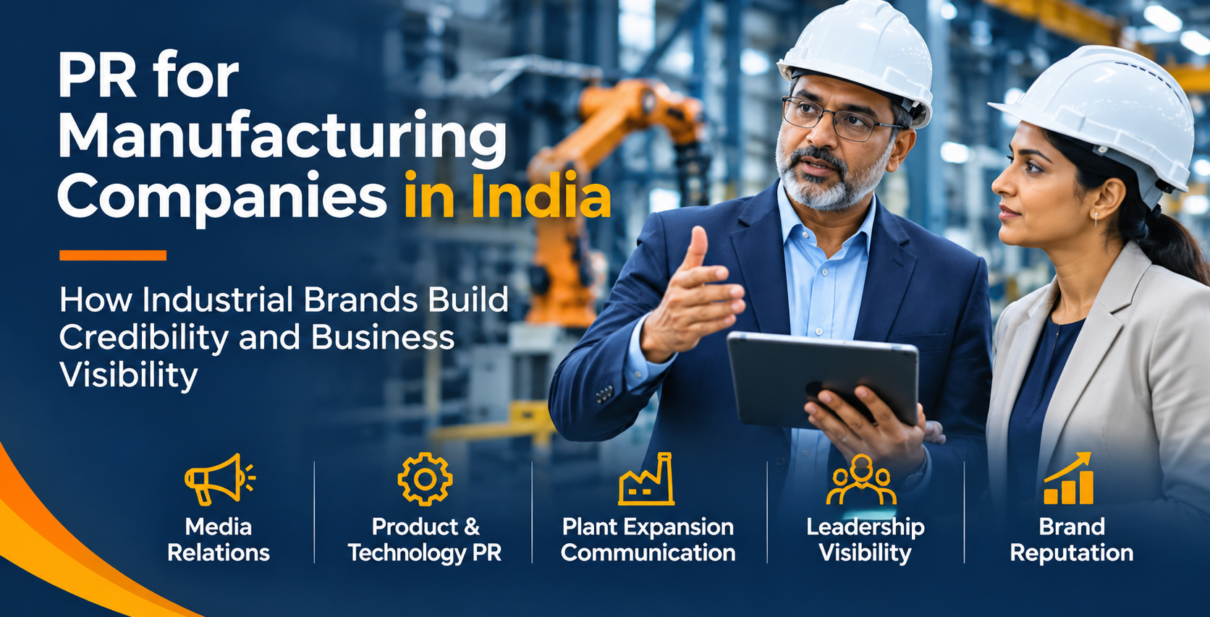
PR for Manufacturing Companies India
Manufacturing companies often have a strong business story to tell. They invest in technology, expand production capacity, improve product quality, develop new solutions, enter new markets and build long-term relationships with customers and suppliers.
Yet many industrial businesses communicate these developments only through their websites, sales presentations or occasional announcements.
Public Relations can help manufacturing companies communicate their capabilities to a wider audience through business media, industry publications, expert commentary, corporate storytelling and strategic media relations.
For B2B manufacturers, PR is particularly relevant because buying decisions often involve technical evaluation, long sales cycles, multiple stakeholders and a high level of trust.
A company may manufacture an excellent product, but potential buyers, industry partners and investors may still have limited understanding of its capabilities.
A focused manufacturing PR strategy can help bridge that gap.
What Is PR for Manufacturing Companies India?
Manufacturing PR is the strategic communication of a company’s products, industrial capabilities, business developments, leadership expertise and market relevance.
It involves identifying stories that matter to business audiences and presenting them through suitable media and communication channels.
Manufacturing PR may include:
- Corporate media relations.
- Product and technology announcements.
- Factory and facility expansion communication.
- B2B thought leadership.
- Leadership profiling.
- Industry interviews.
- Trade media outreach.
- Digital PR.
- Corporate reputation management.
- Crisis communication.
- Event and exhibition PR.
- Sustainability and innovation communication.
The strategy should depend on the company’s industry, products, customer base and business goals.
A steel manufacturer, industrial machinery company, auto-component supplier, electronics manufacturer and chemical company will have different communication requirements.
Why Manufacturing Companies in India Need Strategic PR
India’s manufacturing sector includes businesses across engineering, electronics, chemicals, automotive, pharmaceuticals, textiles, machinery, infrastructure materials and many other industries.
The sector also includes a large number of MSMEs operating as manufacturers, suppliers, distributors, component producers and export businesses.
IBEF’s August 2026 MSME overview reports that MSMEs account for approximately 35.4% of manufacturing output and 48.58% of India’s exports. These figures illustrate the importance of smaller and mid-sized businesses in India’s industrial economy.
For manufacturers, communication can help explain what the company produces, which industries it serves, what differentiates its capabilities and why business partners should consider working with it.
PR can support this through credible media visibility, leadership communication, industry positioning and relevant corporate stories.
7 PR Opportunities Manufacturing Companies Should Use
1. New Product Launches and Technology Developments
Manufacturers frequently introduce new products, equipment, materials, production processes and technical solutions.
A product launch can be an opportunity for media communication when the development has a clear industry relevance.
Instead of announcing only that a new product has been launched, explain:
- The problem it addresses.
- The industry it serves.
- Its practical application.
- The technical improvement, if verified.
- How it differs from existing solutions.
- Why the development matters to customers or the sector.
For example, an industrial automation company launching a new inspection system could develop a story around improving production quality checks, reducing manual inspection steps or helping manufacturers monitor production more efficiently.
The communication should use verified information and avoid unsupported performance claims.
2. Plant Expansion and Manufacturing Capacity
Facility expansions, new manufacturing units and capacity additions can create media opportunities.
A company expanding its plant in Manesar, Faridabad, Noida, Bhiwadi or another industrial location may have a story around investment, production capability, new technology, regional industrial development or supply-chain requirements.
A strong announcement should include confirmed information such as:
- Location of the facility.
- Investment, where approved for disclosure.
- Capacity details, where available.
- Products or components being manufactured.
- Expansion timeline.
- Business objectives.
- Employment or operational details, if verified.
The news angle should focus on what the expansion means for the company, its customers or the industrial sector.
3. Manufacturing Innovation and R&D
Innovation stories can help industrial businesses move beyond routine product communication.
Manufacturers may have developments in automation, materials engineering, energy efficiency, process technology, precision engineering, robotics, quality testing or product design.
A PR agency can work with technical teams to identify developments that can be explained clearly to journalists and business audiences.
The goal is to translate technical expertise into useful industry information without oversimplifying the engineering behind it.
4. Export Growth and International Business
Manufacturers supplying international markets may have opportunities to communicate their export capabilities, global partnerships, new market entry, international certifications and supply-chain relationships.
These stories may be relevant to business media, trade publications, industry associations and regional publications.
For example, a component manufacturer supplying customers in Europe could communicate its export expansion, manufacturing standards, product capabilities and role in the supply chain, provided those details are approved and documented.
Export-related PR should focus on verified business milestones rather than broad claims about global leadership.
5. Leadership and Industry Thought Leadership
Manufacturing leaders have practical knowledge of industry challenges.
Managing Directors, plant heads, technical leaders and business executives can contribute expert commentary on subjects such as:
- Industry transformation.
- Automation and manufacturing technology.
- Supply-chain resilience.
- Quality management.
- Industrial workforce skills.
- Export competitiveness.
- Energy efficiency.
- Engineering innovation.
- Industry policy developments.
Thought leadership can take the form of interviews, opinion articles, expert commentary, industry panels and business-media discussions.
The strongest leadership communication comes from the executive’s experience and actual knowledge of the subject.
6. Certifications, Quality and Operational Milestones
Quality certifications, testing capabilities, new production standards, awards and technical milestones can support corporate communication.
However, a certification announcement needs to be specific.
Explain the certification name, issuing body, relevant facility or product scope, date and business significance.
For example, a manufacturing company receiving a new quality certification may communicate how the certification applies to a particular facility or production process.
Avoid presenting certifications as proof of broader capabilities they do not cover.
7. Sustainability and Responsible Manufacturing
Manufacturers are increasingly communicating energy use, waste management, water conservation, responsible sourcing and other environmental or operational initiatives.
These subjects can provide useful PR stories when supported by actual data.
A sustainability announcement should include:
- The initiative undertaken.
- The location or scope.
- The baseline, where relevant.
- Measured results.
- The method used to calculate those results.
- Any external verification, if applicable.
Statements such as “green manufacturing,” “carbon neutral” or “zero waste” should be used only when the company can substantiate them.
Specific facts are more useful to journalists and stakeholders than broad sustainability claims.
How a PR Agency Builds a Manufacturing Company’s Media Visibility
A manufacturing PR campaign should begin with the company’s business and communication objectives.
Step 1: Understand the Company and Its Market
The agency should understand the manufacturing business before developing stories.
This includes its product portfolio, production capabilities, customers, industry segments, competitive position, technical advantages and expansion plans.
It should also understand the company’s confidentiality requirements and which information can be shared publicly.
Step 2: Identify the Target Audience
Manufacturing PR can serve different audiences.
| Audience | Communication objective |
|---|---|
| Industrial buyers | Explain product capabilities and applications |
| OEMs | Establish supplier credibility and technical expertise |
| Distributors | Communicate product range and market developments |
| Business media | Share company growth, expansion and industry developments |
| Trade publications | Explain technical developments and sector insights |
| Investors | Communicate strategy, growth, leadership and milestones |
| Employees | Build understanding of the company’s direction |
| Industry associations | Participate in sector discussions and initiatives |
Not every story should target every audience.
The media selection should reflect the business objective of the announcement.
Step 3: Develop a Manufacturing Story Bank
Companies should maintain a list of stories that can be developed over time.
A story bank can include:
- Product launches.
- Plant expansion.
- Technology upgrades.
- New certifications.
- Export milestones.
- Leadership appointments.
- Customer applications.
- Industry research.
- Sustainability initiatives.
- Company awards.
- Industry events.
- Expert commentary.
This makes PR more planned and less dependent on last-minute announcements.
Step 4: Build a Media Relations Plan
The agency should identify business, trade, industrial, regional and relevant national publications.
A media pitch should explain why the story is relevant to that publication’s audience.
A technical story may be suitable for an engineering publication, while a company expansion may be more relevant to business media or regional publications.
The same announcement should not be sent indiscriminately to every journalist.
Step 5: Coordinate PR with Sales and Marketing
PR should complement the manufacturer’s sales and marketing activities.
Published media coverage can be shared through the company website, LinkedIn, sales presentations, newsletters, distributor communication and customer outreach.
For example, a manufacturing company announcing a new technology capability may use the media story in its sales communication to help explain the development to prospective buyers.
This does not mean media coverage automatically creates sales leads. It provides a communication asset that can be used within the broader sales process.
What Should a Manufacturing PR Campaign Include?
A structured manufacturing PR engagement may include the following deliverables:
| Deliverable | Purpose |
|---|---|
| PR audit | Review current media presence and communication gaps |
| Industry research | Understand competitors, industry trends and media opportunities |
| Communication strategy | Establish objectives, messages and target audiences |
| Story development | Create news angles based on actual company developments |
| Media outreach | Pitch relevant journalists and publications |
| Press releases | Communicate product launches, milestones and announcements |
| Leadership profiling | Develop executive visibility and industry authority |
| Thought leadership | Share expert insights and opinions |
| Digital PR | Support online brand visibility and relevant media mentions |
| Reputation management | Monitor brand perception and communication issues |
| Reporting | Review coverage, message visibility and business-related outcomes |
The exact scope should be agreed before the campaign begins.
How to Choose a PR Agency for a Manufacturing Company
Before appointing a PR agency, evaluate its ability to understand industrial communication.
Industry Understanding
Ask whether the agency understands your product category, industry terminology, customers and business model.
Media Relevance
Review the publications it proposes. Check whether they reach your customers, suppliers, partners, decision-makers or industry stakeholders.
Technical Storytelling
Ask how it will turn technical information into clear stories without changing the facts or oversimplifying your product.
Leadership Communication
Check whether the agency can support interviews, executive profiles, by-lined articles and expert commentary.
Reporting and Accountability
Understand how the agency will report actual coverage, relevant media visibility, message accuracy, campaign progress and business enquiries.
Commercial Scope
Confirm the monthly deliverables, media outreach process, content requirements, approvals, campaign duration and fees.
Avoid choosing an agency only because it promises a certain number of media placements. Publication relevance, story quality and audience fit matter.
What Should Manufacturing Companies Measure in PR?
A PR campaign should be evaluated against the company’s communication objectives.
Useful metrics include:
- Relevant media coverage secured.
- Industry publications reached.
- Company and leadership mentions.
- Message inclusion in published stories.
- Quality of media coverage.
- Referral traffic from published articles.
- Brand search trends.
- Engagement with company announcements.
- Enquiries influenced by PR.
- Qualified leads.
- Sales meetings supported by PR.
- PR-assisted pipeline opportunities.
Manufacturers with longer B2B sales cycles should connect PR activity with CRM data wherever possible.
A buyer may see an article today, research the company later, visit its website and contact the sales team several weeks after the initial media exposure.
For this reason, PR should be measured over a reasonable period rather than through immediate leads alone.
Why AdventPR for Manufacturing PR?
AdventPR works across Public Relations, Media Relations, Corporate Communications, Digital PR, Reputation Management, Crisis Communication and related communication services.
For manufacturing companies, the communication strategy can be built around business developments, industrial expertise, leadership, technology, expansion, corporate reputation and industry positioning.
The agency’s PR approach can support:
- Manufacturing brand positioning.
- Industrial media relations.
- Corporate announcements.
- Product and technology communication.
- Executive thought leadership.
- Digital PR and online visibility.
- Reputation management.
- Crisis communication.
The campaign should be tailored to the manufacturer’s industry, business priorities, target audience and communication objectives.
Looking for a PR Agency for Your Manufacturing Company?
Is your company expanding production capacity, launching a new product, entering export markets, developing new manufacturing technology or looking to strengthen its corporate reputation?
AdventPR can discuss your PR requirements and identify suitable communication opportunities for your business.
Contact AdventPR to discuss a manufacturing PR strategy focused on relevant media visibility, credible industry communication and long-term brand positioning.
Advent Public Relations
Website: https://adventpr.com/
Email: info@adventpr.com
Phone: +91 93199 71631
Explore PR services in Delhi NCR or contact the AdventPR team to discuss your requirements.