



- November 23, 2026
- by adventpr
- Guide, Industry insights, Posts
- 69 Views
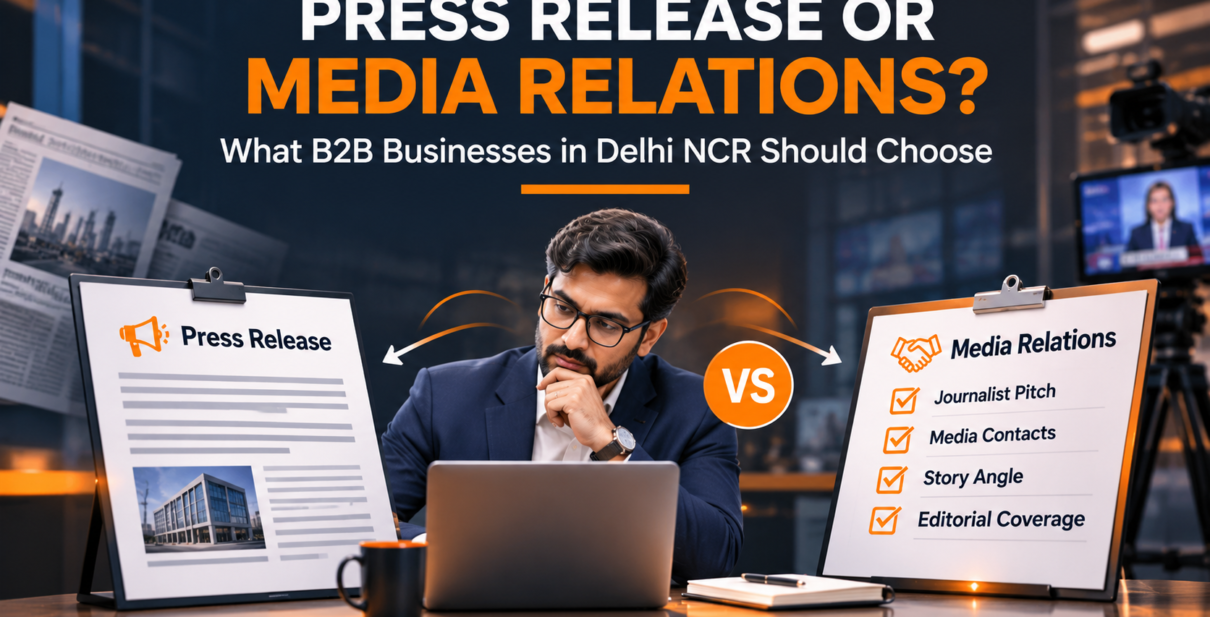
Press Release vs Media Relations
Businesses often approach a PR agency with one objective: get media coverage.
But getting a company announcement distributed and getting a journalist interested in a story are two different communication activities.
Press release distribution helps businesses share official announcements through selected distribution channels. Media relations focuses on developing relevant stories, approaching journalists, arranging interviews, and earning editorial coverage.
For a business in Delhi NCR, the choice depends on what it wants to communicate, who it wants to reach, and what kind of visibility it expects.
A product launch, funding announcement, corporate expansion, industry insight, or leadership interview may require a different approach. Choosing the right PR service can help businesses use their communication budgets more effectively.
What Is Press Release vs Media Relations?
Press release distribution is the process of publishing or distributing an official company announcement through a network of media, news distribution platforms, or selected publications.
A press release usually communicates a specific development, such as:
- A new product or service launch.
- A funding announcement.
- A company expansion.
- A new partnership.
- An appointment or leadership change.
- An event announcement.
- A business milestone.
- A corporate update.
The release is written in a structured format containing the announcement, relevant details, company information, and contact details.
Distribution can help make an announcement publicly available and provide businesses with publication links or distribution records, depending on the service selected.
However, press release distribution does not automatically mean that a journalist will independently investigate the company, interview its leadership, or write a separate editorial story.
Businesses should understand exactly where their announcement will appear and whether the placement is earned, syndicated, sponsored, or part of a paid distribution package.
What Is Media Relations?
Media relations is a broader and more strategic public relations activity focused on building relationships with journalists, editors, reporters, news desks, and relevant publications.
The objective is to identify stories that have genuine editorial value and present them to the media outlets most likely to find them relevant.
Media relations may involve:
- Journalist and publication research.
- Story-angle development.
- Personalised media pitching.
- Interviews with founders and executives.
- Expert commentary.
- Business features.
- Opinion articles and bylines.
- Press briefings.
- Media follow-ups.
- Coverage monitoring and reporting.
Unlike a distribution campaign, media relations is built around the journalist’s interest in the story and the audience it serves.
The agency must understand the company, identify what makes the story relevant and approach the appropriate media contacts with useful information.
Editorial decisions remain with the journalist and publication. A PR agency cannot guarantee that an earned pitch will be published.
Press Release Distribution vs Media Relations: The Difference
| Parameter | Press Release Distribution | Media Relations |
|---|---|---|
| Primary objective | Publish or distribute an official announcement | Earn relevant editorial coverage |
| Approach | Distribution through selected channels | Targeted outreach to journalists |
| Content | Formal company announcement | Story angle tailored to the journalist |
| Media interaction | May involve limited direct interaction | Pitching, interviews and follow-ups |
| Typical use | Launches, announcements, milestones | Features, interviews, expert opinions, business stories |
| Coverage | Distribution or paid/syndicated publication, depending on package | Editorial coverage, if accepted |
| Control | Greater control over release wording and timing | Publication controls final story and timing |
| Reporting | Distribution records, links and placements | Coverage links, interviews, responses and qualitative analysis |
| Best suited for | Announcements that need a public record | Businesses seeking meaningful media attention |
Both services can be useful. The important thing is to understand what each one can realistically deliver.
When Should a Company Choose Press Release Distribution?
Press release distribution is useful when the company has a clear announcement and wants to communicate it in a formal, structured format.
1. Product launches
If a company is launching a new product, technology or service, a press release can communicate its features, availability, launch date and business relevance.
For example, a Gurugram-based technology company launching a new enterprise platform may want to formally announce the product and make its information accessible to customers, partners and media.
Distribution can support the announcement. If the launch has a strong market angle, targeted media pitching can be added to the campaign.
2. Funding and business announcements
Companies announcing funding, acquisitions, partnerships, expansion or major milestones may benefit from an official release.
The announcement creates a verified source of information about the development, while media relations can help explore whether the story has additional relevance to business or industry publications.
3. Corporate announcements
A company may need to communicate leadership appointments, new offices, business restructuring, strategic partnerships or other important developments.
A press release provides an organised way to share the official information.
4. Events and industry participation
Companies participating in major exhibitions, conferences, trade events or industry programmes may use distribution to announce their participation or share event-related developments.
If the event includes original research, an important industry discussion or a major business announcement, a separate media pitch may be more useful than simply distributing an event notice.
When Should a Company Invest in Media Relations?
Media relations becomes more valuable when the business has a story that requires context, explanation or a specific audience.
1. When the company wants business media coverage
A company may want to be featured in business publications, industry magazines or technology news platforms.
The agency needs to understand what makes the company relevant to the publication’s audience.
A business announcement alone may not be enough. A stronger story might explain how the company is responding to a market change, solving an industry problem, developing a new technology or contributing to a larger business trend.
2. When the founder or CEO needs visibility
Founder and leadership interviews can help communicate expertise, business decisions, industry perspectives and company direction.
A media relations agency can identify relevant interview opportunities, prepare talking points and help the spokesperson communicate clearly.
This is especially useful for B2B companies where credibility, leadership expertise and long-term business relationships influence decisions.
3. When the business has expertise but no clear media story
Many companies have useful industry knowledge but struggle to convert it into a story.
A manufacturing company may understand a supply-chain challenge. A fintech company may have insight into digital financial behaviour. A SaaS company may understand how businesses are changing their operations.
Media relations can help turn that expertise into:
- Expert commentary.
- Industry analysis.
- Interviews.
- Opinion articles.
- Business features.
- Data-led stories.
The company does not always need to announce something new. It may have an opportunity to contribute to a story already being covered by journalists.
4. When the company wants consistent visibility
A single announcement may generate a short period of attention.
Companies seeking sustained visibility need a broader media relations programme built around multiple story opportunities throughout the year.
This may include product developments, market insights, leadership interviews, research, business milestones, industry commentary and relevant news events.
The objective is to build a recognisable presence in the publications that matter to the business.
What Makes a Business Story Newsworthy?
One of the biggest mistakes companies make is confusing business importance with newsworthiness.
A development may be important to the company but not relevant to a publication’s audience.
For example, announcing a new office may matter internally. However, a journalist may be more interested in what the expansion means for employment, the industry, regional investment or the company’s growth strategy.
A strong media story usually answers several questions:
Is there a clear reason to publish it now?
The story should have a timely angle. It may connect to a market development, a new finding, a current industry issue or a significant business event.
Does it matter beyond the company?
A story is stronger when it provides information, insight or relevance to readers outside the organisation.
Can the company prove its claims?
Data, documents, customer evidence, verified facts and credible spokespersons can strengthen a pitch.
Is there a useful expert available?
A journalist may need a person who can explain the subject, answer questions and provide context.
Is it relevant to that publication?
A story intended for a technology publication may need a different angle from one intended for a business newspaper or a regional publication.
The story should be developed around the publication’s audience rather than around the company’s preferred promotional language.
What Journalists Expect From a Media Pitch
A media pitch is a short, personalised communication that introduces a story idea to a journalist.
It should make clear why the journalist should consider covering the story.
According to Cision’s 2026 State of the Media survey, 82% of reporters said relevance to their audience or beat is a must-have before they consider a pitch. The survey also reports that 29% of journalists receive more than 50 pitches weekly.
These findings are from a survey of journalists and are not India-specific. Still, they reinforce a useful point for businesses seeking media coverage: a pitch needs to be relevant, concise and supported by useful information.
A media pitch should generally include:
1. A clear subject line
The journalist should understand the story at a glance.
2. A strong opening
Explain the story and why it matters now.
3. Supporting evidence
Include verified data, research, examples, business developments or other information that supports the angle.
4. A relevant spokesperson
Offer an executive or subject-matter expert who can discuss the story.
5. Useful assets
Provide supporting documents, photographs, data or other assets when relevant.
6. A simple next step
Offer an interview, additional information or access to the spokesperson.
A media relations agency should personalise the pitch to the journalist and their coverage area. Sending the same email to hundreds of unrelated media contacts is unlikely to build strong relationships.
Example: How Media Relations Can Work for a B2B Company in Delhi NCR
Consider a Noida-based enterprise technology company introducing a new automation solution.
A basic press release might announce the product, explain its features and provide company information.
A media relations campaign could explore several additional angles:
- How automation is changing a specific industry.
- What operational problem the technology addresses.
- The business implications for companies adopting automation.
- An interview with the founder or technical leader.
- Data or research from the company’s customers, if verified and available.
- An expert perspective on the wider technology market.
The release may be suitable for distribution. The additional stories would need individual pitches and relevant journalist targeting.
The same principle applies to manufacturing, healthcare, fintech, real estate, hospitality, education and other B2B sectors.
A PR campaign should start with the story and the audience, then decide which communication channel is appropriate.
Should Companies Use Both Press Release Distribution and Media Relations?
In many cases, yes.
A company may have an announcement that needs formal distribution and a wider story that deserves targeted media outreach.
For example, a company entering a new market may:
- Prepare an official press release with verified details.
- Identify business and industry publications relevant to the development.
- Develop a story angle for each selected media category.
- Offer interviews with the leadership team.
- Distribute the official announcement through suitable channels.
- Follow up on relevant journalist enquiries.
- Track coverage, links, audience relevance and business enquiries.
This approach can combine announcement visibility with the possibility of earned editorial coverage.
The two activities should be planned together rather than treated as interchangeable services.
How to Choose a Media Relations Agency in Delhi NCR
Before hiring a PR agency, businesses should evaluate the strategy, process and proposed deliverables.
1. Ask how the agency develops story angles
The agency should understand your business, industry, audience and news before recommending outreach.
Ask what stories it sees in your company and why those stories might interest journalists.
2. Review relevant media experience
Ask for examples of work in your sector or with similar business objectives.
Relevant experience may include technology, finance, manufacturing, healthcare, infrastructure, startups or corporate communication.
3. Understand the media targeting strategy
Ask which types of publications and journalists the agency plans to target and why they are relevant to your audience.
A publication’s name alone is not enough. The coverage should fit your business and communication goals.
4. Ask for the scope of work
A PR proposal should define whether it includes:
- Story development.
- Press release writing.
- Media list research.
- Journalist pitching.
- Interviews.
- Spokesperson preparation.
- Media monitoring.
- Coverage reporting.
- Paid distribution, if required.
5. Clarify earned and paid media
Ask whether the proposed placements are editorially earned, syndicated, sponsored or paid.
A responsible agency should explain the difference and report it transparently.
6. Understand reporting and measurement
The agency should report more than the number of press releases sent.
Relevant metrics may include publication quality, story relevance, message inclusion, interviews secured, coverage links, referral traffic and qualified enquiries.
What Should a PR Agency Proposal Include?
Before beginning a media relations campaign, ask for a written proposal containing:
- Communication objectives.
- Target audience.
- Proposed media categories.
- Story angles.
- Media outreach strategy.
- Deliverables.
- Timeline.
- Spokesperson requirements.
- Approval process.
- Reporting format.
- Fees and additional charges.
This gives the company a clear understanding of the work involved and makes it easier to evaluate different PR proposals.
Looking for a Media Relations Agency in Delhi NCR?
If your company wants business media coverage, leadership visibility, industry features, product launch communication or stronger corporate reputation, choosing the right media relations approach is the first step.
AdventPR provides Public Relations, Media Relations, Digital PR, Corporate Communications, Reputation Management and related communication services for businesses.
The team can review your announcement, business objectives, target audience and media requirements to identify a suitable communication strategy.
Before you invest in distribution or media outreach, understand what your story needs.
Speak with AdventPR about your media relations requirements.
Advent Public Relations
Website: https://adventpr.com/
Email: info@adventpr.com
Phone: +91 93199 71631
Explore our PR agency services in Delhi NCR.
Frequently Asked Questions
Press release distribution shares an official announcement through selected channels. Media relations involves developing story angles, pitching journalists, arranging interviews and working to earn editorial coverage.
Neither is universally better. Distribution is useful for formal announcements, while media relations is useful when a company wants to develop stories for specific journalists, publications and audiences.
Distribution may guarantee publication on the specific distribution service or paid platform included in a package. It does not guarantee independent editorial coverage in a newspaper or news publication.
The cost depends on the campaign scope, target media, industry, number of story opportunities, spokesperson support, duration and reporting requirements. A one-time announcement and a monthly media relations programme will have different costs.
A company should identify relevant news, develop a credible story angle, prepare verified facts, select suitable journalists and publications, offer an expert spokesperson and follow up professionally.
A media relations agency develops stories, researches journalists, pitches media, coordinates interviews, prepares spokespeople and monitors coverage.
Relevant editorial coverage can help a company build visibility and provide independent context about its business. The value depends on the publication, story relevance, accuracy and audience.