



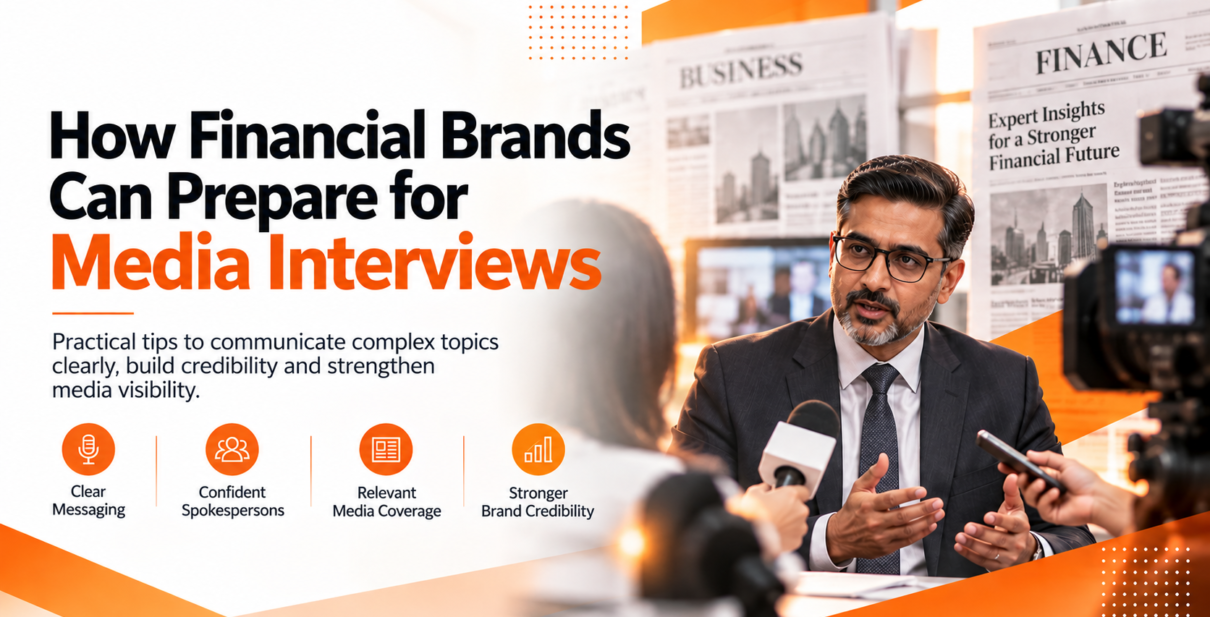
When a financial company’s founder, CEO or subject-matter expert speaks to the media, every answer can influence how audiences understand the business. Financial media interview preparation helps spokespeople communicate verified information clearly, answer difficult questions confidently and establish credibility with journalists.
For banks, NBFCs, FinTech companies, insurance providers and investment businesses, a successful interview starts well before the camera begins recording or the journalist asks the first question.
The objective is to explain the company’s expertise accurately, provide useful context and make complex financial subjects understandable to the audience.
Why Financial Media Interview Preparation Important for Financial Brands
Financial services often involve technical terminology, sensitive business information and claims that require careful verification.
An unclear statement can create confusion. An unsupported claim can damage credibility. An answer that sounds promotional may fail to address what the journalist or audience actually wants to know.
Preparation gives spokespeople a clear understanding of the interview’s purpose, the facts they can discuss and the messages they need to communicate.
It also helps communication teams identify potential risks before they become public issues.
1. Understand the Journalist, Publication and Audience
Every interview has a different purpose.
A business publication may focus on company strategy, leadership decisions or business expansion. A financial journalist may ask about market developments, sector trends or the implications of a company announcement. A technology publication may want to understand the product, technology or customer problem behind a FinTech business.
Before an interview, research the journalist’s recent work, the publication’s audience and the likely angle of the conversation.
Ask three questions:
- What is the journalist trying to explain?
- What information would be useful to the audience?
- What can the spokesperson contribute that is accurate and relevant?
These answers help the PR team prepare a focused briefing instead of a generic company introduction.
2. Build Three Clear Core Messages
Spokespeople should understand the main points they want the audience to remember.
Prepare three concise messages covering:
The business: What the company does and whom it serves.
The expertise: What the spokesperson can explain using evidence, experience or verified information.
The relevance: Why the subject matters to customers, businesses or the wider industry.
Each message should be supported by facts or examples. Avoid slogans that make broad claims without evidence.
A spokesperson should be able to explain these messages in ordinary language without sounding as though they are reading a corporate script.
3. Make Complex Financial Topics Easy to Understand
Financial terminology may be familiar to industry professionals but confusing to a general audience.
Replace unnecessary jargon with plain explanations. Define abbreviations the first time they appear. Use practical examples when they improve understanding, and distinguish clearly between verified results, projections and opinions.
For example, rather than describing a product with a series of technical features, explain the problem it is designed to address and how it works.
Simplification should never remove important qualifications or make a financial product sound safer or more certain than it is.
4. Prepare for Difficult Questions
A media briefing should include questions that the spokesperson hopes to receive and questions that they would rather avoid.
These may concern customer complaints, business performance, product limitations, cybersecurity, regulatory developments, competitive pressure or an earlier public statement.
For each sensitive topic, establish:
- What facts have been verified?
- What information can be disclosed?
- What remains uncertain or is still being investigated?
- Which questions require legal, compliance or management review?
When an answer is unknown, the spokesperson should say so rather than speculate. If appropriate, they can offer to verify the information and follow up.
A credible response acknowledges the question, explains what is known and avoids unsupported reassurance.
5. Establish Clear Approval and Disclosure Processes
Financial communications may require review by legal, compliance, investor relations or senior management teams.
Prepare a fact sheet containing approved company information, relevant dates, verified figures, definitions and any necessary disclosures. Confirm that figures and descriptions match the information approved for public communication.
Special care is needed when discussing investment products, expected performance, financial projections, business results or regulatory matters.
Do not use guarantees, exaggerated performance claims or statements that imply a financial outcome is certain unless the wording and claim are expressly permitted and substantiated.
The PR team should know who can approve sensitive statements and how corrections will be handled if information changes.
6. Practise Before the Interview
A briefing document alone cannot prepare someone for every interview format.
Conduct a mock interview using likely questions, follow-up questions and a few challenging scenarios.
Review whether the spokesperson answers the question directly, explains the issue clearly and supports claims with facts. For video interviews, pay attention to pace, body language and concise answers. For print interviews, focus on accurate quotations and avoiding unnecessary technical language.
Practice should improve clarity and confidence, not encourage evasive or memorised responses.
7. Coordinate Media Relations and Follow-Up
Preparation is part of a wider media relations process.
Before the interview, confirm the spokesperson’s availability, format, timing and approved background material. Afterward, provide any agreed follow-up information promptly.
Monitor the published coverage and check whether names, titles, figures and quotations have been represented accurately. If a material factual error appears, follow the publication’s established correction process.
Track the quality and relevance of coverage rather than treating every mention as equally valuable.
Useful measures include placement in relevant publications, accurate message inclusion, spokesperson visibility, referral traffic and engagement with the resulting content. The appropriate measures depend on the original communications objective.
8. Connect Media Credibility With Digital PR
Media interviews can contribute to a financial brand’s wider digital presence when the resulting coverage is supported by useful, consistent information on its website and other owned channels.
A company can publish a spokesperson biography, explain its areas of expertise, link to relevant research and maintain clear service descriptions. Where publication rights permit, it may share or reference published interviews through its website and social channels.
These activities help readers understand who the company is and what its experts can discuss. They also make the relationship between the brand, its leadership and its subject matter clearer online.
Digital PR should focus on credible references and useful information. No agency can guarantee that a particular search engine or AI platform will rank, cite or recommend a brand.
How AdventPR Can Support Financial Media Visibility
A planned approach to financial communications connects the story, the spokesperson, the journalist and the intended audience.
AdventPR works across financial communications, media relations, reputation management and investor relations. For financial brands, the value of a coordinated programme lies in communicating business developments accurately while giving journalists access to relevant expertise and perspectives.
Explore AdventPR’s financial PR content and guidance on choosing a financial PR agency in India.
If your business is preparing for an important announcement, executive interview or broader media campaign, develop the messaging and approval process before outreach begins.
Frequently Asked Questions
It is the process of preparing financial industry spokespeople to answer media questions accurately, explain complex subjects clearly and communicate approved messages relevant to the interview.
Preparation helps FinTech spokespeople explain their products, technology, business developments and industry views without relying on unnecessary jargon or making unsupported claims.
A spokesperson builds credibility by providing accurate information, acknowledging uncertainty, explaining complex issues clearly and supporting statements with verifiable facts.
They should avoid speculation, unverified figures, unsupported promises, misleading comparisons and statements that have not received the necessary approval.
It helps align the spokesperson’s expertise with the intended story, improves communication quality and supports consistent messaging across media relations and broader corporate communications.
Published interviews may create useful third-party references and opportunities for content sharing. Their contribution to search visibility depends on the quality, relevance and accessibility of the resulting content; rankings and AI citations are not guaranteed.