



- August 25, 2026
- by adventpr
- AI Technology, Branding
- 341 Views
Why Chatbot Crisis Communication Is Becoming a PR Issue
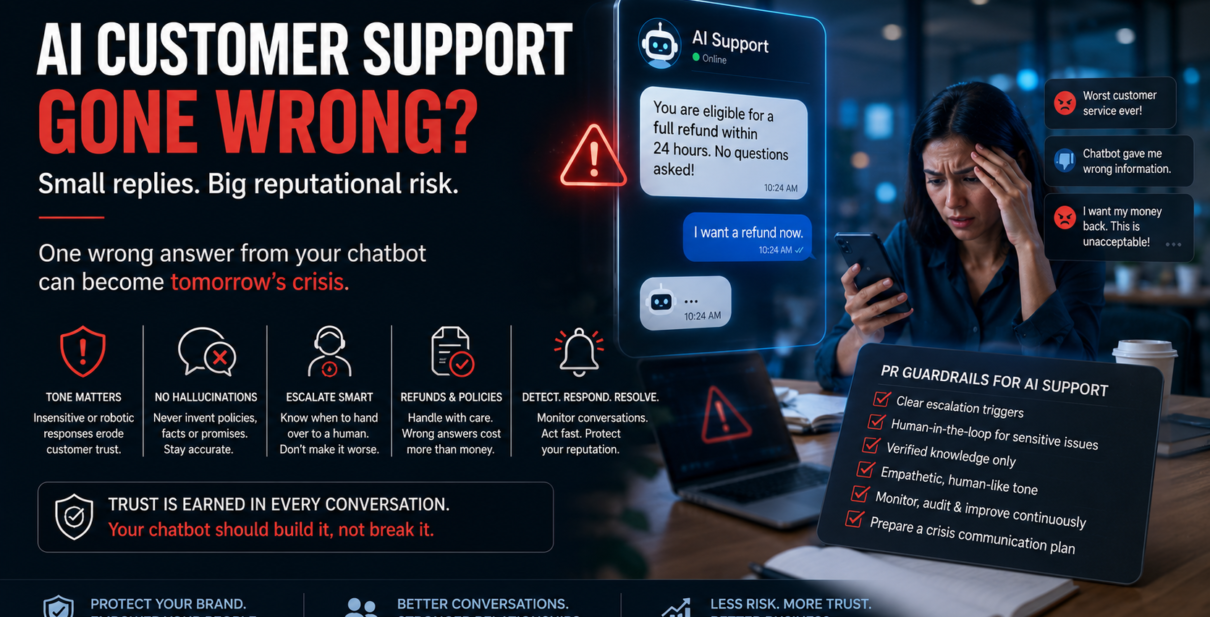
Customer support is often the most direct conversation a customer has with a company. When that conversation is handled by AI, an incorrect answer can quickly become a screenshot, social post, or media story. A 2026 study found that chatbot failures can escalate from customer dissatisfaction into communication crises when systems fail to understand context, demonstrate empathy or resolve issues appropriately.
This makes chatbot crisis communication an important part of modern reputation management.
AI Can Answer Fast but It Can Also Sound Confidently Wrong
AI customer support can automate routine questions, but generative systems can produce incomplete or inaccurate answers. OpenAI explicitly states that model outputs may sometimes be inaccurate and recommends evaluating outputs for accuracy and appropriateness, including human review where appropriate.
For Advent PR, this creates a simple communications principle: never allow automation to become an unchecked source of truth.
Refunds, Policies and Commitments Need Hard Guardrails
The highest risk chatbot conversations are often those involving refunds, pricing, eligibility, account access, cancellations, contractual commitments or policy interpretation.
A useful rule for AI customer support is:
If the answer creates a financial, legal, regulatory or reputational commitment, escalate to a human or controlled workflow.
This prevents a chatbot from confidently promising something the company cannot actually deliver.
Tone Can Turn a Small Error Into a Big Reputation Problem
A technically accurate answer can still be reputationally damaging if it sounds dismissive, robotic or insensitive. Research published in 2026 found that human sourced crisis responses produced stronger perceptions of organizational reputation and credibility than AI disclosed responses in several crisis scenarios.
That means AI chatbot tone should be treated as part of brand voice, not simply a UX setting.
Build Clear Human Escalation Triggers
Every customer facing AI system should have defined escalation rules.
Escalate when the customer:
- Reports a serious service failure
- Disputes a financial charge
- Requests a refund outside standard rules
- Raises a legal or regulatory concern
- Mentions safety, security or privacy
- Repeats the same unresolved complaint
- Uses language indicating significant distress or reputational risk
For Advent PR, these triggers should feed directly into the company’s crisis communication and customer response playbook.
Create a “No Hallucination” Policy
A strong chatbot crisis communication strategy should define what the AI is prohibited from inventing.
The bot should not fabricate:
Refund policies, discounts, product features, legal rights, delivery promises, executive statements, regulatory approvals or customer commitments.
Where information is unavailable, the system should say so and route the customer to an appropriate human or verified source.
Treat Support Screenshots as Potential PR Assets
Customer support conversations can become public instantly. Teams should therefore monitor recurring complaints, unusual chatbot responses and screenshots shared on social platforms.
When a mistake occurs, the response should follow:
Detect → Verify → Contain → Correct → Escalate → Learn
The objective is to solve the customer problem first while preventing a minor interaction from becoming a broader reputation issue.
Why Advent PR Connects AI Support With Reputation Management
At Advent PR, we combine Crisis Communication, Digital PR, Reputation Management, AI Search Optimization, Corporate Communications and Media Relations to help brands prepare for reputation risks created by AI enabled customer interactions.
The goal is not to stop using AI.
It is to make sure AI never becomes your brand’s loudest liability.
Refunds, Policies and Commitments Need Hard Guardrails
The highest risk chatbot conversations are often those involving refunds, pricing, eligibility, account access, cancellations, contractual commitments or policy interpretation.
A useful rule for AI customer support is:
If the answer creates a financial, legal, regulatory or reputational commitment, escalate to a human or controlled workflow.
This prevents a chatbot from confidently promising something the company cannot actually deliver.
Tone Can Turn a Small Error Into a Big Reputation Problem
A technically accurate answer can still be reputationally damaging if it sounds dismissive, robotic or insensitive. Research published in 2026 found that human sourced crisis responses produced stronger perceptions of organizational reputation and credibility than AI disclosed responses in several crisis scenarios.
That means AI chatbot tone should be treated as part of brand voice, not simply a UX setting.
Frequently Asked Questions
Chatbot crisis communication is the process of preparing policies, escalation rules and response frameworks for situations where an AI customer support system creates inaccurate, inappropriate or reputation damaging interactions.
Verify the response, correct the customer quickly, document the failure, identify the underlying cause and determine whether other customers may have received the same incorrect information.
Yes. Research shows chatbot failures can move beyond technical problems into trust and communication issues when customers feel misunderstood, dismissed or misled.
They can support routine workflows, but sensitive refunds, disputes, legal complaints and unusual cases should have controlled escalation and human oversight.
Use verified knowledge sources, controlled workflows, explicit limitations, testing, monitoring and human escalation. AI providers themselves recognize that outputs can be inaccurate and recommend appropriate human review.
Customer support is a public facing brand communication channel. Advent PR can help connect chatbot governance with Crisis Communication, Reputation Management, Digital PR and executive response planning so operational errors do not become avoidable reputation crises.