



Most Indian Brands Are Still Fighting for the Same Attention
If your marketing budget goes almost entirely to Meta and Google, you’re not alone. Most Indian brands keep increasing spend on platforms where competition gets tougher every quarter. At the same time, millions of people spend hours watching live sports, movies, TV shows, and web series on JioHotstar without scrolling past hundreds of competing posts.
That shift matters.
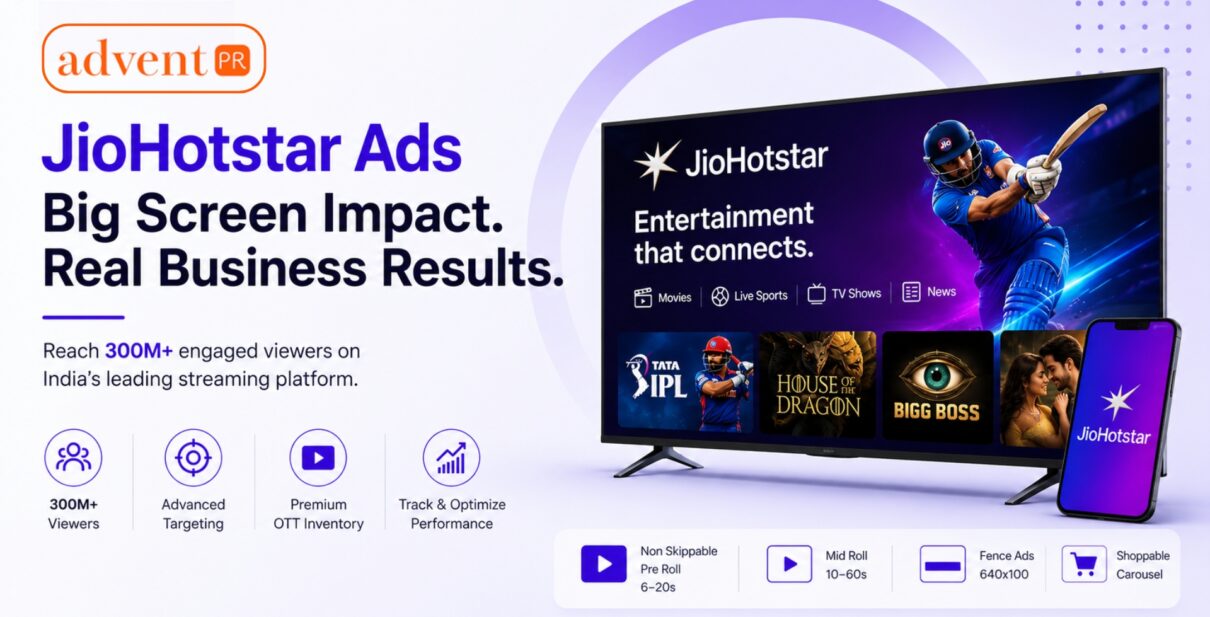
JioHotstar is no longer just a streaming platform. It has become one of India’s biggest digital advertising opportunities, combining telecom data, entertainment behavior, and premium video inventory.
This guide explains what JioHotstar Ads are, who should use them, how much they cost, what ad formats work best, how targeting actually works, and how you can launch your first campaign through the self-serve dashboard.
By the end, you’ll know whether OTT advertising deserves a place in your media mix.
What are JioHotstar Ads and Why They’re Different Now
The merger of Disney+ Hotstar and JioCinema has changed India’s OTT advertising market.
Earlier, advertisers had to choose between different streaming ecosystems. Today, JioHotstar combines premium entertainment, live sports, regional content, and one of India’s largest connected audiences under a single advertising platform.
The bigger advantage comes from data.
Instead of relying only on what people watch, JioHotstar can combine entertainment viewing behavior with insights generated across the wider Jio ecosystem. That includes location signals, device usage, mobile network information, and consumption patterns. When these signals are used together, brands can build more relevant audience segments than traditional OTT platforms could offer on their own.
The result is a stronger audience understanding without depending only on cookies or website activity. Understanding the platform is only useful if it fits your business. Let’s see who should actually advertise here.
Who Should Actually Run Ads Here (and Who Shouldn’t)
JioHotstar isn’t the right platform for every business.
If you’re expecting every impression to generate immediate sales like a Google Search campaign, you’ll probably be disappointed. But if your product benefits from strong visual storytelling and broad awareness, it deserves serious consideration.
Strong Fit
D2C Brands
Fashion, skincare, beauty, nutrition, electronics, furniture, home décor, kitchen products, fitness equipment, and lifestyle brands benefit because premium video helps customers remember products.
BFSI
Insurance companies, investment platforms, fintech apps, and lending businesses can build credibility through high-quality video before driving users into performance campaigns.
FMCG
Mass-market products benefit from a wide reach, especially during major sporting events and entertainment launches.
EdTech
Video demonstrations, student success stories, and expert-led communication work well for education brands targeting parents and young professionals.
Real Estate
Builders can showcase projects, amenities, walkthroughs, and location advantages far better than static social ads.
Moderate Fit
Healthcare providers, travel companies, automobile brands, premium hospitality businesses, and consumer technology products.
If your ideal customer base is only a few thousand decision-makers, LinkedIn or Search advertising will usually produce better results.
Now let’s understand the different ad formats available and where each one makes sense.
Ad Formats Explained
Choosing the wrong format often wastes more money than choosing the wrong audience.
Each format serves a different objective.
1. Non-Skippable Pre-Roll (6–20 Seconds)
This ad appears before the content begins.
Because viewers cannot skip it, every impression delivers the complete message.
Best for
- Product launches
- Brand awareness
- Festival campaigns
- App installs
- Seasonal offers
Example
A skincare brand launches a new sunscreen before summer. Every cricket viewer watches a 15-second video introducing the product before the match begins.
Goal: Maximum awareness.
2. Mid-Roll Ads (10–60 Seconds)
These appear during longer content when viewers are already engaged.
People are less likely to leave because they’re waiting for the show or match to continue.
Best for
- Product demonstrations
- Brand storytelling
- Financial services
- Educational campaigns
- Automotive launches
Example
A fintech platform runs a 30-second ad explaining how SIP investing works during the innings break of a cricket match.
Goal: Education and consideration.
3. Fence Ads (640 × 100 Static)
Fence Ads appear as a banner within supported viewing environments.
They’re less intrusive than video but continuously visible while viewers consume content.
Best for
- Brand reminders
- Limited-time offers
- Website traffic
- App downloads
Limitations
- The creative space is small.
- Complex messaging won’t work.
- Focus on one product, one headline, and one CTA.
Example
An online grocery platform promotes “Free Delivery Above ₹499” with a clean visual and QR code.
Goal: Reinforce an ongoing campaign.
4. Shoppable Carousel
This is one of the most overlooked formats for D2C brands.
Instead of showing one product, you can display multiple products inside a swipeable experience where viewers explore different options without leaving immediately.
It shortens the journey between discovery and purchase.
Best for
- Fashion
- Beauty
- Electronics
- Furniture
- Food brands
- Lifestyle products
Example
A sneaker brand showcases five bestselling shoes with pricing and direct shopping links during a live sports event.
Goal: Product discovery and conversions.
Now that you know the formats, the next question is obvious: how much does this actually cost?
Pricing and Budget Reality Check
One of the biggest myths about OTT advertising is that it’s only for companies with massive television budgets.
That’s no longer true.
JioHotstar Ads generally operate on a CPM (Cost Per Thousand Impressions) model, with pricing starting at around ₹315 CPM for eligible campaigns. Actual CPMs vary depending on inventory, targeting, seasonality, sports events, and competition.
Let’s translate that into practical numbers.
If your monthly budget is ₹50,000
At an average CPM of ₹315:
- Estimated impressions: Around 1.58 lakh
- Estimated unique reach: 60,000–1,10,000 people, depending on frequency and targeting.
If your monthly budget is ₹1 lakh
You can generate approximately 3.17 lakh impressions while testing multiple audience segments and creatives.
If your monthly budget is ₹5 lakh
You’re entering a scale where JioHotstar can become a meaningful awareness channel alongside Meta and Google, especially during premium entertainment and sports events.
How does this compare with Meta?
Meta CPMs in India often range much lower than OTT, especially for broad campaigns. In many cases, you may see CPMs anywhere from ₹80 to ₹250, though premium audiences and competitive categories can cost more.
So yes, JioHotstar impressions are usually more expensive.
But you’re paying for something different.
Your ad appears in a premium, full-screen viewing environment where users are actively watching content instead of scrolling past hundreds of competing posts. That generally leads to stronger attention and higher brand recall, even if it doesn’t always deliver the cheapest clicks.
Is this only for big brands?
No—but it’s also not a platform you should test with ₹10,000 and expect meaningful results.
A monthly budget of ₹50,000 to ₹1 lakh is a reasonable starting point if you’re serious about evaluating OTT advertising. It gives you enough volume to test audiences, creative variations, and placements before deciding whether to scale.
Once you’re comfortable with the budget, the next step is getting your campaign live.
How to Launch on the Self-Serve Dashboard (Step by Step)
JioHotstar now offers a self-serve advertising platform that simplifies campaign creation for brands without needing a large agency setup.
Start by visiting adsmanager.hotstar.com and creating your advertiser account.
Step 1: Set Up Your Account
Complete your business profile, billing information, and payment method. Keep your brand assets and creatives ready before you begin.
Step 2: Choose Your Campaign Objective
Select the goal that matches your campaign.
Common objectives include:
- Brand Awareness
- Reach
- Website Traffic
- Video Views
- App Promotion
Choose only one primary objective for each campaign to keep reporting clear.
Step 3: Define Your Audience
Build your audience using available targeting options such as:
- Geography
- Language
- Age group
- Device type
- Interest categories
- Entertainment preferences
- Sports viewers
Avoid making the audience too narrow during your first campaign.
Step 4: Select the Ad Format
- Pick the format that matches your objective.
- Use short pre-roll videos for awareness.
- Use mid-roll for storytelling.
- Use Fence Ads for reminders.
- Use Shoppable Carousel if your goal is product discovery.
Step 5: Set Budget and Schedule
Choose your total campaign budget, flight dates, frequency, and bidding preferences.
If you’re testing, split the budget across two or three audience groups instead of putting everything into one.
Step 6: Review and Launch
Double-check creative specifications, landing pages, tracking parameters, and targeting before publishing.
After launch, monitor delivery daily during the first week instead of waiting until the campaign ends.
Launching a campaign is straightforward. The real strength lies in how precisely you can choose who sees it.
Targeting Capabilities. What Makes This Actually Powerful
The biggest difference between JioHotstar and many traditional video platforms is the quality of audience signals.
Instead of relying on a single source of information, the platform can combine multiple behavioral indicators to create more useful audience segments.
Jio Mobile Signals
These include:
- Device type
- Network usage
- Approximate location
- Mobile consumption habits
This helps brands deliver ads that are more relevant to different user groups.
Entertainment Viewing Behavior
Someone who regularly watches premium crime series behaves differently from someone who spends weekends watching family movies or regional entertainment.
JioHotstar can organize audiences around these viewing preferences, allowing brands to align messaging with content interests.
Live Sports Audiences
Live cricket remains one of the platform’s strongest advertising opportunities.
During events such as the IPL, brands can reach highly engaged viewers who spend extended periods watching matches. Sports inventory is premium, competitive, and often delivers stronger brand recall than standard digital placements.
Signal-Led Commerce in Simple Terms
Think of it this way.
Instead of showing your ad only because someone visited your website, the platform combines multiple signals—what they watch, how they use their device, where they are, and when they’re active—to identify people who are more likely to care about your product.
No single signal tells the full story. Together, they create a much stronger audience profile.
Good targeting gets people to notice your ad. Good expectations determine whether you call the campaign a success.
What to Realistically Expect (Performance Benchmarks)
JioHotstar should not replace your Meta or Google campaigns.
For most brands, it works best as an upper-funnel channel that creates awareness, builds familiarity, and prepares customers for future conversion campaigns.
If your goal is immediate purchases at the lowest possible cost, Search or Meta will usually remain more efficient.
Where JioHotstar performs well is in making your brand memorable before people start searching or comparing options.
You are likely to see stronger results if:
- Your product has a strong visual appeal.
- Your creative tells a story within the first few seconds.
- You combine OTT campaigns with Meta or Google retargeting.
- You’re launching a new product or entering a new market.
- Brand recall matters as much as immediate conversions.
You may struggle if:
- Your video creative looks like a resized social media ad.
- Your targeting is too broad or completely mismatched.
- Your landing page is slow or confusing.
- You expect every view to generate a purchase.
The strongest campaigns treat OTT as part of a broader marketing strategy rather than a standalone sales channel.
Final Thoughts
JioHotstar Ads won’t replace Meta or Google, but they can add something those platforms often struggle to deliver: sustained attention in a premium viewing environment backed by rich audience signals.
If your brand has the right creative, a monthly budget of at least ₹50,000, and a product that benefits from visual storytelling, OTT advertising deserves a serious test, not because it’s new, but because consumer attention is steadily moving there.
Next Step
Create an account on adsmanager.hotstar.com, launch a small test campaign with one clear objective, measure the results alongside your existing channels, and if you want to reduce the learning curve, work with an experienced media partner who can help you plan, launch, and optimize your first JioHotstar campaign.